


Questions this guide answers
Primary question: How should buyers calculate the total cost of ownership of an industrial floor scrubber?
- Which cost layers should be included in a five-year equipment worksheet?
- How do consumables and downtime change the true cost of a machine?
- When should site fit override a lower TCO estimate?
Direct Answer
Calculate industrial floor scrubber ownership cost with one transparent formula: TCO = purchase, freight, import, commissioning and training + operator labor + water, detergent and energy + consumables + maintenance, spare parts and battery replacement + downtime and backup-machine cost - residual value. Use the same operating period and route assumptions for every candidate. A five-year worksheet should show each input, while cost per cleaned m2 equals total TCO divided by the verified area cleaned during that period. This makes labor, consumables, downtime, parts availability and residual value visible instead of comparing invoice price alone.
| Cost layer | What to include | Why it matters |
|---|---|---|
| Acquisition | Machine, battery, charger, accessories, freight, import, commissioning and training | Defines installed first cost, not lifetime cost. |
| Labor and operation | Operator hours, water, detergent and energy | Usually grows with cleaning frequency and route inefficiency. |
| Consumables and maintenance | Brushes, pads, squeegee rubber, filters, hoses, service labor and batteries | Controls routine cost and uptime. |
| Downtime | Repair delay, unavailable parts, lost service time and backup machine need | Can exceed a small purchase-price saving. |
| End of period | Residual or resale value and disposal cost | Completes the comparison across the same ownership period. |
Decision method
Use the same evidence sequence for every option
-
01
Choose one time horizon and workload
Fix years, annual cleaning hours, labor rate, route area and expected utilization before collecting prices.
Decision output: A comparable TCO baseline.
-
02
Capture all recurring and lifecycle costs
Include labor, utilities, detergent, pads, brushes, squeegees, batteries, planned service, repairs and logistics.
Decision output: A complete cost schedule rather than purchase price alone.
-
03
Price downtime and uncertainty
Model parts lead time, backup equipment, lost shifts, residual value and best, expected and adverse scenarios.
Decision output: A risk-adjusted cost per year and cost per cleaned area.
Compare labor savings with machine cost
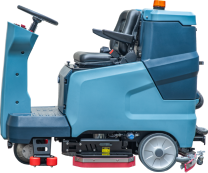
A ride-on scrubber may cost more than a smaller unit, but it can reduce walking time on large routes. The correct comparison is not only machine price; it is machine cost plus labor hours over the expected operating period.
For malls, warehouses and airports, route time and cleaning frequency should be calculated before comparing equipment options.
Consumables and parts decide practical cost
Brushes, pads, squeegee rubber, filters, batteries and hoses need replacement. If parts are hard to identify or slow to supply, the machine may sit idle even though the purchase price was attractive.
A procurement checklist should include common parts, replacement intervals, lead time and who is responsible for support.
Use a five-year worksheet for B2B procurement
A useful worksheet includes purchase price, expected use days, cleaning hours saved, operator cost, consumable budget, battery replacement risk, maintenance labor and downtime allowance.
The result should guide negotiation and model choice, but it should still be validated with sample testing for high-use sites.
Use transparent assumptions in the five-year worksheet
A useful TCO comparison should show its assumptions. At minimum, record purchase price, expected use hours, operator labor rate, consumables, wear parts, battery or charging assumptions, maintenance time, downtime risk and service support. Without these assumptions, a five-year cost number is difficult to verify and can become misleading. Buyers should keep the worksheet editable so site conditions can be changed.
Include consumables and downtime in the same model
Consumables and downtime are often ignored in simple price comparisons. Brushes, pads, squeegee blades, filters, hoses, batteries and service response time can change the real cost of ownership. A low purchase price may still be expensive if spare parts are hard to obtain or if downtime interrupts a cleaning contract. TCO should therefore include parts availability and after-sales workflow, not only the machine invoice.
When TCO should not override site-fit
TCO is a decision tool, not the only decision. A machine with a lower projected cost can still be a poor choice if it cannot pass through doors, cannot clean the required floor type, lacks sufficient water recovery, or cannot be maintained by the local team. The final decision should combine TCO with route fit, floor compatibility, safety, documentation and service support.
Limitations and checks before purchase
- TCO estimates depend on local labor cost, cleaning frequency, spare-part pricing and operating discipline.
- A cheaper machine can be a good choice for light use if spare parts and documentation are reliable.
- For high-traffic facilities, downtime risk should be priced explicitly instead of ignored.
Traceable evidence
Sources and evidence boundaries
These sources separate ELEREIN-published facts from neutral methods, safety guidance and regulatory context.
- Supports
- Life-cycle cost analysis beyond initial acquisition price.
- Boundary
- Buyers must insert their own labor, utilization, maintenance, energy and downtime assumptions.
- Supports
- Planned maintenance, competent work and safe maintenance arrangements.
- Boundary
- The exact model manual and site safety procedure remain controlling documents.
- Supports
- Independent inspection as a method for checking quantity, quality, configuration and shipment evidence.
- Boundary
- The service page is not proof that an inspection occurred or that an ELEREIN product passed.
How to use these sources: Use each source only for the safety, testing, regulatory or procurement principle stated in its boundary. External sources do not certify, endorse or validate an untested ELEREIN model.