


Questions this guide answers
Primary question: How can buyers verify that certificates and declarations apply to the exact cleaning-machine model and market?
- What test results, safety records and efficiency evidence should support a cleaning-equipment proposal?
Direct Answer
Do not approve a cleaning machine from a CE logo, a generic certificate or a model-family claim alone. Match the quotation, nameplate, exact variant, Declaration of Conformity, applicable EU legislation, standards or technical specifications, issue date, signatory, supporting report references, importer information, destination country and document version as one traceable chain. For ELEREIN E60, E100 or E130, the product URL and confirmed baseline specifications can anchor product identity, but they do not establish that any CE document covers the quoted configuration or market.
Decision-page companion
Start with the short decision guide
Use the checklist for the document set and this guide for exact-model, variant, date and market matching.
Certificates and Test Reports Buyer ChecklistScope, date and legal boundary
This is a procurement verification workflow, not legal advice or a conformity assessment. The manufacturer and other economic operators retain their legal responsibilities, and a competent EU product-compliance professional should decide disputed scope.
The legal position is date-sensitive. As of 14 July 2026, Directive 2006/42/EC remains the principal EU machinery act in general application; its machinery document is titled an "EC Declaration of Conformity." Regulation (EU) 2023/1230 generally applies from 20 January 2027 and uses "EU Declaration of Conformity." A buyer planning delivery across that transition should confirm which act applies when the specific product is placed on the market or put into service and whether any transitional provisions affect the file.
CE marking is required only for products covered by EU harmonisation rules that require it. The manufacturer identifies applicable rules, performs the required assessment, compiles technical documentation, signs the declaration and affixes the mark. No central EU body issues a universal "CE certificate." A notified body is involved only where the applicable procedure requires one, so its absence is not automatically a failure.
Start with the market and economic-operator chain
The same machine can have different documentary requirements depending on destination, date, supply role and configuration. Record these fields before reviewing a declaration:
| Field ID | Buyer record | Verification question |
|---|---|---|
| CE-01 | Destination country and site | Is CE marking the relevant market-access regime, and what national language or accompanying-information rules apply? |
| CE-02 | Planned placing-on-market or putting-into-service date | Which version of EU legislation applies on that date? |
| CE-03 | Buyer role | Is the buyer an end user, distributor, EU importer, authorised representative or an entity selling under its own name? |
| CE-04 | Manufacturer legal entity | Does the declaration identify the legal manufacturer by full name and address? |
| CE-05 | EU economic operator where required | Is the relevant importer or authorised-representative information traceable and consistent with the supply chain? |
| CE-06 | Brand and seller | If brand, seller and manufacturer differ, is their relationship documented without substituting a trade name for the legal entity? |
CE marking concerns the EEA market under EU rules; it is not universal proof for every destination. A distributor should separately check the rules for any non-EEA market. Within the EU, instructions and safety information may need a language understood in the destination country under the applicable product rules.
Build the product-identity chain
Create one row for the offered unit and copy identifiers exactly, including punctuation, spaces and suffixes. The chain should run:
Quotation line item -> order specification -> unit nameplate -> Declaration of Conformity -> controlled model/variant annex -> relevant evidence index -> instructions and labels
| Identity field | Source to capture | Acceptance question |
|---|---|---|
| Commercial name | Quote, product page and nameplate | Is the same name used consistently, or is a cross-reference controlled? |
| Model and type | Quote, nameplate and declaration | Does the declaration identify the exact model/type or a clearly defined family that includes it? |
| Variant or revision | Quote suffix, BOM/configuration matrix, labels and declaration annex | Are battery, charger, voltage, controls and safety-relevant options inside the assessed configuration? |
| Serial, batch or production range | Nameplate, delivery record and declaration where used | Can the delivered unit be traced to the declared product? |
| Electrical ratings | Nameplate, quote and approved specification | Do voltage, frequency, charger and other ratings agree? |
| Accessories and attachments | Quote and assessed configuration list | Could an attachment or substitution change risk, applicable legislation or assessment scope? |
| Manual and label versions | Supplied package and document register | Do instructions correspond to the same model, revision and destination language? |
A family declaration can be legitimate, but it needs a controlled bridge to the purchased variant, such as a signed annex, variant matrix or product-code list. Visual similarity and a "same series" email are insufficient. A changed charger, battery, control, protective device, attachment or safety-related software may require an impact review.
Review the declaration field by field
For machinery under Directive 2006/42/EC, Annex II specifies information that includes the manufacturer, the person authorised to compile the technical file, a description and identification of the machinery, relevant legal provisions, notified-body details where appropriate, standards or technical specifications where appropriate, place and date, and the authorised signatory. Use the applicable legal act itself as the controlling checklist.
| Field ID | Declaration check | Buyer action if unclear |
|---|---|---|
| CE-07 | Correct document type and title | Distinguish a Declaration of Conformity from a Declaration of Incorporation, test report, voluntary certificate or marketing statement |
| CE-08 | Issuer legal name and full address | Match the manufacturer or legally relevant representative to the economic-operator chain |
| CE-09 | Product identification | Match model, type, function, commercial name and serial/batch scope to the delivered unit |
| CE-10 | Applicable Union acts | Confirm all legislation identified for the exact product and placement date; do not assume a generic list is complete |
| CE-11 | Harmonised standards or other specifications | Record number, edition/date and the role claimed; verify current OJEU status when presumption of conformity is relied upon |
| CE-12 | Notified body, when applicable | Verify name, four-digit number, legal notification scope, procedure and linked certificate/report |
| CE-13 | Place, issue date, signatory name/title and signature | Confirm the declaration is executed by an authorised person and is not an unsigned template |
| CE-14 | Declaration number and revision | Link the copy to a controlled document register and identify superseded versions |
| CE-15 | Supporting evidence references | Map risk assessment, tests, drawings and instructions by controlled identifier without demanding disclosure beyond the buyer's legal entitlement |
Harmonised standards are generally voluntary. When their references are published in the Official Journal of the European Union, they can provide a presumption of conformity only for the legal requirements they cover. A standard list is not a substitute for applicable legislation, risk assessment or the signed declaration. Conversely, a blank standards field is not automatically proof of nonconformity; it requires a competent review of the conformity route and technical basis.
Distinguish the main document types
| Document or mark | What it can show | What it cannot prove by itself |
|---|---|---|
| CE mark on the unit | The manufacturer has affixed the required marking | Exact declaration scope, variant, evidence quality or market package |
| Signed Declaration of Conformity | The manufacturer's formal declaration for the identified product and laws | That the delivered unit matches the declared configuration if identity fields conflict |
| Notified-body certificate | A legally relevant third-party result when the applicable procedure requires that body and scope | Compliance outside the body's notification scope or coverage of unlisted variants |
| Voluntary certificate or verification letter | Additional testing or review described in its own scope | Legal permission to use CE marking or replacement of the required declaration |
| Test report | Results for the sample, method and standard identified | Coverage of another model, production revision or all applicable legislation |
| Technical file index | Traceability between risks, design evidence, tests and instructions | Automatic buyer entitlement to the manufacturer's complete confidential technical file |
Official EU guidance warns that voluntary certificates may be misleading when presented as legal CE evidence. Check whether a body acted as a notified body under the relevant legislation and procedure, rather than relying on its logo or general reputation.
Match report references to the quoted variant
For each safety or performance report, record its number, laboratory, date, standard edition, tested model/build, configuration, deviations, result and linked file revision. One motor, charger or base-machine report does not automatically cover a changed option; a broad family label needs a controlled model matrix. Keep amendments with the reports they modify and verify accreditation scope only when accredited testing is claimed. Cleaning-performance evidence belongs in the proposal pack but is separate from CE conformity.
Version and change-control test
Use the latest applicable controlled version, then check backward to the delivered production date. The declaration and technical documentation must be kept up to date when relevant product, legislation or entity details change.
Trigger a documented impact review for changes to the economic operator, model/revision, relevant production site, battery, charger, motor, electrical architecture, safety-related control, risk-control component, attachment, intended use, applicable law, standard or destination information. The review decides whether the declaration remains applicable, needs an update or requires more assessment.
Illustrative matching example
This example is illustrative and does not describe an ELEREIN product or document.
A quote identifies "Machine M-100, Variant L, 24 V charger package." The nameplate says M-100-L, but the declaration lists only M-100 and has no annex. Status is conditional for procurement review, with market release on hold until a controlled link covers M-100-L and its charger. If the nameplate says M-120 and no document includes M-120, identity fails.
Pass, conditional-pass and fail logic
| Decision | Boundary | Procurement consequence |
|---|---|---|
| Pass | Destination and date are defined; legal manufacturer and economic-operator chain are consistent; exact model/variant is traceable; the applicable declaration is signed and controlled; legislation, standards/specifications and notified-body role where relevant are coherent; reports and instructions match the configuration | Approve the documentary gate only for the identified unit, variant, market and version |
| Conditional pass | A limited documentary ambiguity appears capable of controlled correction, such as a missing variant annex or standard edition; there is no known contradiction or safety issue | Hold shipment, placement on the market and final acceptance until named evidence closes the condition; conditional pass is not legal release |
| Fail | Legal entity is unresolved; model/variant is outside scope; wrong document type or legal regime is used; declaration is unsigned or untraceable; a safety-relevant change is unassessed; a voluntary certificate is offered instead of the required declaration; or documents materially contradict the unit | Reject the documentary package and obtain a corrected conformity route before market placement |
An unreadable scan, cropped signature page or certificate screenshot is not evidence of scope. Require the complete controlled document and retain its checksum or document-control metadata where the procurement system supports it.
ELEREIN product-data connection
The following confirmed fields can help a buyer detect an identity mismatch. They are not conformity evidence and do not establish CE coverage.
| ELEREIN authority model page | Confirmed baseline identity fields | CE verification still required |
|---|---|---|
| E60 Floor Scrubber | 510 mm cleaning width; 750 mm squeegee; 1380 x 600 x 1200 mm; 188 kg net | Legal manufacturer, exact revision/configuration, nameplate, declaration, laws, reports, market and document version |
| E100 Floor Scrubber | 760 mm cleaning width; 1000 mm squeegee; 1650 x 900 x 1300 mm; 422 kg net | Legal manufacturer, exact revision/configuration, nameplate, declaration, laws, reports, market and document version |
| E130 Floor Scrubber | 860 mm cleaning width; 1000 mm squeegee; 1720 x 1010 x 1430 mm; 530 kg net | Legal manufacturer, exact revision/configuration, nameplate, declaration, laws, reports, market and document version |
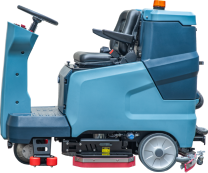
Net weight is not operating weight, and the dimensions do not by themselves define the working or transport envelope. ELEREIN's official taxonomy identifies E60 as walk-behind and E100/E130 as ride-on, but these baseline fields do not establish electrical configuration or certificate scope. Any customized configuration requires final engineering and conformity review; logo, color, packaging, manual language, configuration or accessory changes are not automatically inside an earlier document merely because the base model name is unchanged.
Buyer evidence checklist
- Destination country, placement date and buyer/importer/distributor role
- Quote, order and configuration revision
- Unit and component nameplate photographs
- Exact legal manufacturer and relevant EU economic-operator details
- Complete signed Declaration of Conformity and controlled annexes
- Model/variant matrix linking every suffix and option
- Applicable legislation list for the placement date
- Standards or technical-specification references with versions
- Notified-body identity, scope and certificate link where legally applicable
- Test-report index tied to model, sample, configuration and declaration revision
- Destination-language instructions, safety information and labels
- Change-control statement for customized or substituted components
- Reviewer, decision, open conditions, closure evidence and approval date
Limitations
This workflow cannot determine conformity when the unit, technical evidence or supply-chain facts conflict. It does not grant unrestricted access to a manufacturer's confidential technical file; evidence requests should reflect applicable rights, duties and confidentiality controls.
EU legislation, harmonised-standard references and market guidance can change. Recheck official sources for the actual placement date and destination, especially for products crossing the 20 January 2027 Machinery Regulation transition.
Related guides
Traceable evidence
Sources and evidence boundaries
These sources separate ELEREIN-published context from external regulatory, safety, inspection and maintenance guidance.
- Supports
- The purpose, scope and limits of CE marking for products placed on the EEA market.
- Boundary
- Applicable legislation and the conformity route depend on the exact product, configuration and market date.
- Supports
- Manufacturer responsibilities for conformity assessment, technical files and declarations.
- Boundary
- The guidance does not authenticate a supplier document or prove conformity for a delivered machine.
- Supports
- Primary legal text for machinery obligations and economic-operator responsibilities.
- Boundary
- Legal applicability and transition timing require review for the exact machine and placing-on-market date.
- Supports
- A verification route for accredited management-system certificates and certification bodies.
- Boundary
- Search results must still be matched to the exact legal entity, scope, site and certificate status.
How to use these sources: Use each source only for the safety, testing, regulatory or procurement principle stated in its boundary. External sources do not certify, endorse or validate an untested ELEREIN model.