


Questions this guide answers
Primary question: How should a buyer score, document and sign off a commercial cleaning-machine sample test?
- Why should a commercial floor-cleaning machine be tested on the real floor, soil and route before approval?
Direct Answer
A sample should be accepted only after the exact quoted machine and configuration complete a pre-approved route on representative floor and soil, with measured cleaning, water recovery, runtime, access, service and operator results. Freeze the test method and pass boundaries before the demonstration, preserve raw failures as well as successful runs, and use critical gates rather than an average score. The signed result applies only to the tested configuration and conditions; it is not certification, a production-lot inspection or proof that another model will perform the same way.
Decision-page companion
Start with the short decision guide
The checklist defines what to test; this companion page narrows the task to scoring, exceptions and sign-off.
Commercial Cleaning Equipment Sample Test ChecklistScope and assumptions
This protocol is for distributors, importers, contractors and facility buyers evaluating a sample before purchase or batch approval. It covers identity, site fit, cleaning, residual water, loaded runtime, tank service, daily care, documents and sign-off. It does not replace conformity assessment, production-lot inspection, durability testing, floor-friction measurement or facility safety procedures. Isolate the authorised test area and use only approved routes, chemicals, charging and wastewater processes.
Write the acceptance requirement before selecting the sample
The buyer should issue a short user requirement and test plan before the sample arrives. Otherwise, a sales demonstration can produce attractive images without answering whether the machine fits the actual operation.
| Requirement group | Fields to approve before testing |
|---|---|
| Intended work | Site, zones, cleanable route, frequency, shift window and reopening requirement |
| Access | Doorways, aisles, lifts, thresholds, turns, storage, charging, refill and drain routes |
| Floor and soil | Material, coating, texture, joints, current damage, target soil and loose-debris control |
| Cleaning process | Approved brush or pad, chemistry, dilution, passes, dwell, solution setting and pre-treatment |
| Recovery | Test maneuvers, observation delay, fixed-area measurement method and maximum residual-water boundary |
| Runtime | Required net loaded time, gross route window, reserve, charge condition and end point |
| Operator and service | Intended operator, daily-care steps, consumables, tools, training and document language |
| Decision | Critical failures, conditional items, retest method, witnesses and signing authority |
Do not use total building area as the route. Exclude inaccessible spaces and separate open lanes, narrow aisles, edges and manual-only areas. Record cleaning frequency: a route cleaned twice per shift creates a different duty cycle from the same area cleaned once.
Freeze the sample identity and configuration
Photograph all nameplates and assign a test ID. The first worksheet should identify:
- Brand, exact model, serial number and revision
- Machine format as stated in the controlled quotation, without inference from appearance
- Battery and charger manufacturer, model, chemistry, voltage and capacity where available
- Brush or pad, holder, pressure/mode and condition
- Squeegee assembly, blades, condition and approved adjustment
- Solution and recovery settings, accessories and control/software version where shown
- Tank state, hour meter, prior sample use and any repaired or replaced parts
- Quote number, specification revision, manual revision and declaration/document references
If a safety-relevant or performance-relevant item changes during the trial, open a configuration-change row. Record the reason, approver and affected tests. Do not silently substitute a pad, blade, battery, charger or operating mode and continue under the original test ID.
Select representative test zones
Use the expected floor, including representative texture, joints, wear and soil within safe limits. Public-facility tests should include turns and edges that control reopening; warehouse tests should include representative aisle ends, tire marks, dust and joints. Test materially different zones separately. Do not use an empty smooth lane to represent an occupied textured route, or create an artificial failure with undocumented soil. Identify any standardized artificial soil and keep that result separate from the real-route trial.
Before-and-after photographs need fixed camera positions, lighting, scale and route markers. Photographs support traceability but are not a quantitative result unless the image method has been validated. Where the buyer requires a measured soil-removal or surface-change result, specify the instrument, calibration, sampling grid and limit in advance.
Field-level sample protocol
Run the phases in order. A failed identity, safety or access gate should stop performance testing until it is resolved.
| Field ID | Test | Required record | Critical boundary |
|---|---|---|---|
| SA-01 | Product identity | Quote, model, serial, revision, nameplates and configuration | Delivered sample is traceable to the quoted unit |
| SA-02 | Compliance-document match | Declaration, instructions, labels, market and versions | No known model, entity, market or document contradiction |
| SA-03 | Pre-use safety inspection | Controls, guards, cables, connectors, leaks, alarms and visible damage | No unsafe condition before operation |
| SA-04 | Door and aisle access | Narrowest measured points with full supplied envelope | Unit passes without contact or unsafe improvisation |
| SA-05 | Turn and route access | Both directions, aisle ends, thresholds and normal repositioning | Required route is completed within approved clearances |
| SA-06 | Lift, floor and transport load | Verified operating weight and facility rating where relevant | Net weight alone is not used for load approval |
| SA-07 | Floor compatibility | Small-area trial, surface inspection and approved chemistry | No unacceptable scratch, coating change, discoloration or damage |
| SA-08 | Target-soil cleaning | Defined soil, process, passes and before/after measurement | Buyer-approved cleaning boundary is met |
| SA-09 | Edge cleaning | Fixed edge route and residual soil map | Edge result meets the stated scope; manual follow-up is quantified where allowed |
| SA-10 | Water recovery | Straight, left/right turns, edges, joints and U-turns | Every critical residual-water result meets its limit |
| SA-11 | Reopening time | Fixed observation method and traffic-control period | Facility release rule is met before barriers are removed |
| SA-12 | Loaded runtime | Drive/traction, brush/pad, solution and recovery active on representative route | Required work time plus reserve is achieved |
| SA-13 | Gross route time | Cleaning plus normal refill, drain, debris and inspection stops | Route fits the operating window |
| SA-14 | Tank cycle | Measured solution added, recovered volume and service frequency | No unplanned interruption or unsafe wastewater handling |
| SA-15 | Operator handling | Intended operator, controls, visibility, maneuvering and emergency actions | Operator completes required tasks safely after instruction |
| SA-16 | Daily care | Empty, rinse, clean squeegee/filter, inspect consumables and prepare for charging/storage | Required work is practical and no uncontrolled spill occurs |
| SA-17 | Noise and environment | Site method and limit where relevant | No unverified "quiet" claim substitutes for site measurement |
| SA-18 | Evidence and handover | Raw data, photos, manuals, parts, training and open issues | Package is complete enough to reproduce the decision |
For SA-02, use the separate CE declaration model and market verification workflow. A functional sample pass cannot cure a conformity-document mismatch.
Run the cleaning phase under controlled conditions
First perform a short familiarisation run that is not scored. Then return the floor and machine to the defined starting condition. Record solution volume, chemistry and dilution; brush or pad; operating settings; operator; route; start time; passes; dwell; interruptions and environmental conditions.
Evaluate cleaning and surface condition separately: a process may remove soil while damaging a coating. Require both soil-removal and no-unacceptable-change results, following floor requirements and the chemical safety data sheet.
Repeat critical segments; straight passes do not replace turns, edges and joints. Retain failures, change one factor at a time and show the original result, correction and retest.
Test water recovery as a safety gate
Use a route containing straight pickup, left and right 90-degree turns, a representative 180-degree U-turn, both edge directions where applicable, joints and the highest-risk traffic zone. Set observation times before testing. Combine a visual trail map with fixed-area gravimetric blotting when a quantitative boundary is required.
Averages do not override a wet tail or pool. Apply the limit to every critical sample and repeat. Keep barriers and warning controls in place until the facility's release rule is met. The detailed method is in the turn, edge and U-turn water-recovery protocol.
Test runtime as a route result
Charge the documented battery with the documented approved charger to the defined full condition. Run the required machine systems on the representative route and keep separate net loaded and gross route clocks. Log battery indications, completed work, turns, solution use, recovered water, refill/drain stops, alarms and any decline in cleaning or recovery.
For this buyer-defined protocol, use two valid runs when practical and assess the lower result against the required work block and reserve. A different pre-agreed run count is valid when the buyer records the reason and acceptance method. Do not extrapolate from a dashboard percentage or call a no-load drive test representative. The full-system loaded runtime protocol provides the field sheet and calculations.
Use critical gates, not a blended score
| Decision | Required logic | Sign-off consequence |
|---|---|---|
| Pass | Every critical identity, safety, access, floor, cleaning, recovery, runtime and document gate passes; required evidence is complete; only stated noncritical observations remain | Approve the exact tested configuration for the stated conditions |
| Conditional pass | All safety-critical and performance-critical gates pass, but a limited noncritical item has a named owner, objective closure evidence, deadline and affected retest scope | No automatic batch release; close conditions in writing before the defined approval gate |
| Fail | Any critical gate fails, an unsafe condition occurs, the route or floor is not representative, required performance is missed, a compliance contradiction remains, or a condition cannot be objectively closed | Reject the tested configuration or correct and repeat the defined tests |
| Invalid - no decision | Identity, method, instrument, route or configuration control is lost | Repeat from a valid controlled starting point |
Conditional pass must not be used for residual water above the safety limit, floor damage, unresolved compliance scope, unsafe charging or a machine that cannot complete the required route. Those are failures until corrected and successfully retested.
Illustrative decision example
This example is illustrative only and is not an ELEREIN result.
A sample passes 17 of 18 worksheet rows but leaves one U-turn sample above the buyer's residual-water maximum. The overall decision is fail, not 94% pass and not conditional pass. After a documented squeegee correction, the buyer repeats SA-10 on all required maneuvers and rechecks the straight baseline. Only a complete passing retest can close that critical gate.
Connect sample approval to production control
The signed sample should become a controlled reference sample only when the contract identifies its model, serial number, configuration, photographs, approved deviations and document revision. Batch units should be checked against that frozen reference through a separate production and pre-shipment inspection plan.
ELEREIN's confirmed commercial baselines are MOQ 10 units, a 7-day sample cycle and a 15-day batch-production cycle after required details and approvals. These are planning baselines subject to configuration, payment, stock, region, order quantity, approval gates and final contract; they are not unconditional delivery promises. Define when each clock starts and whether packing, inspection, transport and customs time are included.
Customization may cover logo, color, packaging, manual language, configuration and accessory combinations, with no new mold opening, all subject to final engineering review and contract. Cosmetic changes still require label and document review. Configuration or accessory changes require an impact assessment and repetition of every affected acceptance test; a sample approval does not automatically transfer to a changed production BOM.
ELEREIN product-data connection
Use these confirmed facts to shortlist and identify a sample. None of them proves route completion, operating weight, floor compatibility, water recovery or loaded runtime.
| Model | Cleaning/squeegee width | Solution/recovery tanks | Published baseline runtime | Dimensions; net weight | Route-area screening reference |
|---|---|---|---|---|---|
| E60 | 510/750 mm | 50/60 L | 4-5 h | 1380 x 600 x 1200 mm; 188 kg net | Up to 10,000 m2 under confirmed route conditions |
| E100 | 760/1000 mm | 90/100 L | 5-6 h | 1650 x 900 x 1300 mm; 422 kg net | Up to 20,000 m2 under confirmed route conditions |
| E130 | 860/1000 mm | 120/130 L | 6-8 h | 1720 x 1010 x 1430 mm; 530 kg net | Up to 25,000 m2 under confirmed route conditions |
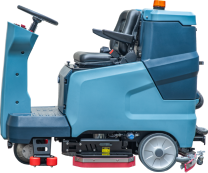
The area values are screening references, not productivity or shift guarantees. Runtime ranges are published baselines, not full-load test results. Dimensions do not replace measurement of the supplied working envelope, and net weight is not operating weight. E60 is a walk-behind floor scrubber and E100/E130 are ride-on floor scrubbers; the sample record must still identify the exact tested configuration.
Buyer evidence checklist
- User requirement, approved protocol and acceptance revision
- Site route, dimensions, floor zones, traffic window and service points
- Exact machine, serial, battery, charger, brush/pad, squeegee, settings and accessories
- Nameplate, quote, manual, declaration and controlled configuration references
- Soil, chemistry, dilution, SDS and floor-compatibility approval
- Before/after images with fixed method and all quantitative raw data
- Water-recovery samples, route maps and reopening records
- Loaded runtime, gross route, tank and recharge records
- Operator and daily-care observations
- Every failure, invalid run, correction and retest
- Pass, conditional-pass or fail decision with explicit scope and limitations
- Buyer, supplier, operator and technical witness signatures
- Production freeze, allowed deviations and change-control rule
Limitations
A sample result is a snapshot of one unit, route, operator, floor, soil, chemistry and date. It does not prove production consistency, durability, battery cycle life, every accessory combination or performance on another site. A short demonstration should be followed by risk-based production inspection, incoming inspection and longer operational monitoring where the purchase scale warrants it.
External manufacturer and laboratory guidance can help define fields and methods, but competitor data must never be presented as ELEREIN performance. Publish an ELEREIN measured result only with the actual dated record, exact configuration, conditions, raw method, limitations and approval to disclose it.
Related guides
Traceable evidence
Sources and evidence boundaries
These sources separate ELEREIN-published context from external regulatory, safety, inspection and maintenance guidance.
- Supports
- Independent inspection as a method for checking quantity, quality, configuration and shipment evidence.
- Boundary
- The service page is not proof that an inspection occurred or that an ELEREIN product passed.
- Supports
- Repeatable performance and safety testing context for cleaning equipment.
- Boundary
- A laboratory service page is not a model-level report or certification.
- Supports
- Safety context for commercial floor treatment machines, including scrubbers and sweepers.
- Boundary
- A standard listing does not certify an ELEREIN model or replace the exact declaration, report or manual.
- Supports
- Safety context for commercial wet and dry vacuum-cleaning equipment.
- Boundary
- The standard page is a method and scope reference, not model-level conformity evidence.
How to use these sources: Use each source only for the safety, testing, regulatory or procurement principle stated in its boundary. External sources do not certify, endorse or validate an untested ELEREIN model.
Official product context