


Questions this guide answers
Primary question: How should floor-scrubber operating weight be calculated for lifts, floors, ramps and loading routes?
- Can a cleaning machine fit through doors, enter lifts and be allocated safely across floors?
Direct Answer
Do not approve a floor scrubber for a lift, suspended floor, ramp, liftgate or vehicle from published net weight alone. Define the exact machine configuration, weigh or calculate every credible load state, verify the complete movement envelope, and obtain the facility or transport approval required for concentrated loads, gradients and load securement. A calculation below a posted capacity is a screening result, not a structural-safety statement.
Decision-page companion
Start with the short decision guide
Start with confirmed specification fields, then obtain qualified approval for lifts, floors, ramps and transport loads.
How to Read Cleaning Equipment Specification SheetsScope and assumptions
This method is for pre-purchase and route-planning decisions. It helps a buyer identify missing data, reject an obviously unsuitable route and prepare a complete evidence pack for the building owner, lift provider, structural engineer, safety team, carrier or loading-equipment owner.
It does not certify a floor, lift, ramp, dock, vehicle or tie-down arrangement. Capacity depends on more than total mass: wheel reactions, load position, dynamic movement, surface condition, braking, ramp transitions, lift leveling, vehicle axle limits and applicable rules may all matter. The approving competent person must select the governing standard and safety factors.
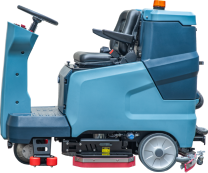
Use the exact quoted configuration. Battery, charger, attachments, squeegee, brush or pad assembly, packaging and regional options may change both mass and envelope. The E60 is a walk-behind floor scrubber; the E100 and E130 are ride-on floor scrubbers. Those format labels do not establish configured operating weight, transport weight or access envelope.
Use one load vocabulary
The word "weight" is often used loosely in equipment literature. Record mass in kg and define what is included. If an engineer needs force in kN or a floor design load, let that calculation follow the applicable structural method rather than a marketing worksheet.
| Load term | Required definition | What it must not be used to assume |
|---|---|---|
| Net weight | Published machine mass with an explicit inclusion list | That batteries, accessories, liquids, operator or packaging are included |
| Dry weight | Exact configured machine without operating liquids; state whether batteries and attachments are installed | That every supplier uses the same dry-weight definition |
| Curb weight | A supplier-defined ready-to-operate mass, more common for road vehicles; require a component list if used for cleaning equipment | That it automatically includes an operator, full tanks or every option |
| Operating weight | Configured machine plus the liquids, attachments, carried items and people present in the stated operating condition | That one operating state represents filling, cleaning, maintenance and lift travel |
| Maximum credible service load | The heaviest condition that can reasonably occur during filling, draining, fault recovery, maintenance or movement | That both nominal tanks can simply be counted as full without checking whether that state is physically credible |
| Transport or shipping load | Machine in its dispatch state plus pallet, crate, packaging, loose accessories, spares and any handling frame traveling with it | That machine net weight equals vehicle payload or liftgate demand |
"Curb weight" is not a useful procurement field unless the quotation defines it. Prefer a component ledger and measured load states.
Build a state-specific mass ledger
Create one row for every item that can enter or leave the load. Use controlled documents for fixed components and a calibrated scale for the assembled machine whenever practical.
| Ledger item | Evidence | State A: configured dry | State B: normal start | State C: highest credible operating or service state | State D: transport |
|---|---|---|---|---|---|
| Base machine | Scale ticket or approved specification | kg | kg | kg | kg |
| Installed battery set | Configuration and scale record | Included or kg | Included or kg | Included or kg | Included, removed or kg |
| Solution or other onboard liquid | Measured fill volume and density | 0 | kg | kg | Usually drained; verify |
| Recovered liquid and collected soil | Test or conservative credible condition | 0 | kg | kg | 0 unless permitted otherwise |
| Attached tools and options | Part list and measured mass | kg | kg | kg | Installed or packed separately |
| Operator, escort or service person | Site planning mass | 0 | kg | kg | 0 unless traveling with the load |
| Pallet, crate, spares and restraints | Packing list and scale record | 0 | 0 | 0 | kg |
| Total | Sum without double counting | kg | kg | kg | kg |
Use these screening formulas:
Operating mass = configured dry machine
               + onboard liquid in the stated condition
               + attached accessories and carried items
               + operator or escort where applicable
               + collected soil or other credible added load

Transport consignment mass = machine mass in dispatch condition
                           + pallet or crate
                           + loose accessories and spares
                           + handling or restraint equipment carried as cargo
Check three common errors before accepting the total:
- Do not add a battery twice if it is already included in the documented machine mass.
- Do not add both tank nameplate capacities as full merely because two numbers appear on a datasheet. During normal cleaning, water is transferred from one tank to the other; the highest credible state must be established for the actual hydraulic arrangement and service procedure.
- Do not treat nominal tank capacity as measured usable volume or liquid mass. Record the actual fill condition and liquid density when it materially affects the decision.
Illustrative calculation, not an ELEREIN result
Assume a generic floor-cleaning machine has a measured configured dry mass of 300 kg including its installed battery. The planned lift movement includes 60 kg of solution, a 10 kg attachment, an 85 kg operator and a 5 kg allowance for collected material:
Screening operating mass = 300 + 60 + 10 + 85 + 5 = 460 kg
If the site requires a 75 kg escort in the lift, the lift movement total becomes 535 kg. Against a posted 600 kg rated load, the arithmetic difference is only 65 kg. That does not approve the movement: the lift owner must still confirm allowed use, platform and doorway fit, load distribution, leveling, floor interface, occupancy rules and any required margin.
For transport, assume the machine is drained, the 300 kg configured mass is unchanged, packaging weighs 45 kg and loose spares weigh 20 kg:
Screening consignment mass = 300 + 45 + 20 = 365 kg
The carrier must still check vehicle payload, axle distribution, liftgate or ramp rating, restraint points and cargo-securing requirements. Do not transfer the 460 kg lift state or the 365 kg transport state to another decision without checking what each includes.
Check the complete access and load route
Start at storage or the delivery vehicle and end at every cleaning and service zone. A route that passes one lift can still fail at a fire door, threshold, floor cover, ramp transition, drain room or parking bay.
| Route element | Measure or obtain | Immediate rejection condition | Approval owner |
|---|---|---|---|
| Doors and corridors | Clear width and height, handles, closers, thresholds, approach and turn space | Verified operating or transport envelope cannot pass with the site's approved clearance | Facility team |
| Lift | Rated load, door opening, cab dimensions, sill gap, leveling, floor finish, access policy and occupants | Any credible lift load exceeds the rating, or configuration/envelope is unknown | Lift owner or service provider |
| Suspended floor or slab | Permitted distributed and concentrated loads, condition, joints, covers and restricted paths | No authoritative load information for the proposed wheel path | Building owner and structural professional |
| Ramp | Rise, run, cross slope, length, surface, drainage, edge protection, transitions and stopping plan | Machine capability, braking or permitted operating condition is unconfirmed | Equipment supplier and site safety owner |
| Dock, liftgate or loading ramp | Rated capacity, platform size, approach angle, surface, edge controls and operating procedure | Equipment rating is below the complete load or the transition cannot be negotiated | Loading-equipment owner |
| Vehicle | Payload, axle limits, load position, internal envelope and restraint system | Consignment or axle demand exceeds a limit, or no approved securement plan exists | Carrier or transport specialist |
Lifts: rated capacity is necessary but not sufficient
Compare the heaviest permitted lift state with the lift's posted and documented rating. Then verify door clear opening at the narrowest point, platform depth and width, turning approach, sill gap, floor-level difference, automatic-door timing and the ability to position the load as the lift owner requires.
Record whether the operator remains with the machine, whether an escort is required and whether cleaning equipment containing liquid may use the lift. A spill-control plan and route closure may be necessary. Never wedge doors, bridge an unapproved gap or assume a passenger lift permits the proposed equipment movement.
Floors: separate gross mass from wheel and point loads
Dividing total mass by the machine's rectangular footprint produces an average that can hide the actual demand. Wheels create concentrated reactions; those reactions may be unequal and may increase during braking, turning, crossing a joint or entering a lift. Covers, grates, raised floors, ramps and damaged slab edges can govern even when the surrounding floor is adequate.
Provide the structural reviewer with total mass by state, wheel count and locations, verified wheel or contact dimensions, load distribution or measured wheel reactions, travel path, speed and operating events. If these fields are unavailable, the correct result is "structural approval pending," not an estimated safe floor load.
Ramps: measure geometry without claiming capability
Record longitudinal gradient as:
Gradient (%) = vertical rise / horizontal run x 100
Also record cross slope, total length, top and bottom transitions, surface contamination, drainage direction, edge protection, pedestrian or vehicle conflicts, and where the machine must stop. Percent gradient and degrees are different units; label the measurement.
The measurement does not prove that a candidate can climb, descend, stop or clean on the ramp. Require model- and configuration-specific instructions for operating and transport gradients, load state, braking and prohibited use. No confirmed E60, E100 or E130 gradeability figure is used in this guide.
Acceptance and failure boundaries
Use three statuses so a preliminary screen is not mistaken for approval.
| Status | Boundary |
|---|---|
| Fail | A credible load exceeds an authoritative equipment rating; the verified envelope cannot pass; required braking, grade, floor or loading evidence is absent and no alternate route is approved; or the proposed movement conflicts with site safety rules |
| Conditional | Arithmetic capacity and measured geometry appear viable, but operating weight, wheel loads, turning envelope, exact configuration, lift permission, ramp capability or transport securement still needs authoritative confirmation |
| Approved for the stated route | The exact configuration and load state are documented; every route segment has an owner-approved method; required structural, lift, loading and transport reviews are complete; and the acceptance record names its limits and revision |
Approval applies only to the recorded route, load state and configuration. A new battery, accessory, packaging method, floor assignment, ramp or transport vehicle triggers review.
Connect the method to ELEREIN E-series data
The following confirmed facts support early screening. They do not provide operating weight, wheel loads, turning radius, gradeability, transport dimensions or structural approval.
| Model | Confirmed overall dimensions | Confirmed net weight | Confirmed solution/recovery tanks | Confirmed squeegee width | Correct use in this plan |
|---|---|---|---|---|---|
| E60 | 1380 x 600 x 1200 mm | 188 kg | 50/60 L | 750 mm | Screen body size and known net mass, then obtain configured dry and operating states |
| E100 | 1650 x 900 x 1300 mm | 422 kg | 90/100 L | 1000 mm | Screen access, then verify full operating envelope and load ledger |
| E130 | 1720 x 1010 x 1430 mm | 530 kg | 120/130 L | 1000 mm | Screen access, then verify full operating envelope and load ledger |
Net weight is not operating weight. Nominal tank capacities do not justify adding both tanks as simultaneously full, and the published overall dimensions do not establish the swept turning envelope. ELEREIN's route-area screening references and baseline runtime ranges are unrelated to structural capacity and must not be used in this calculation.
Buyer evidence checklist
- Exact model, serial or revision, quoted configuration and machine-format confirmation
- Signed definition of net, dry, curb, operating and transport mass fields used
- Scale ticket for configured dry, normal operating and highest credible service states
- Battery, accessory, liquid, operator, packaging and spare-parts inclusion ledger
- Operating, turning, service and transport envelope drawings
- Wheel layout, contact dimensions and load distribution or wheel-reaction evidence
- Dated route plan with doors, lifts, floors, thresholds, ramps, docks and vehicles
- Lift rating, use permission and platform/interface review
- Structural review for concentrated and dynamic loads where required
- Manufacturer-approved ramp, braking and movement conditions for the exact configuration
- Liftgate, loading-ramp, vehicle payload, axle and cargo-securement approval
- Named owner, date, revision, assumptions and expiry or change trigger for every approval
Limitations
This worksheet cannot replace a structural calculation, lift inspection, machine manual, risk assessment, carrier load plan or local legal review. It does not establish a universal clearance, spare capacity or dynamic factor. Where the machine's configured mass, wheel reactions, format, ramp limits or transport details are not documented, the route remains unapproved.
Related guides
Traceable evidence
Sources and evidence boundaries
These sources separate ELEREIN-published context from external regulatory, safety, inspection and maintenance guidance.
- Supports
- Work-equipment suitability, training, maintenance and safe-use principles.
- Boundary
- General work-equipment guidance does not establish model fit or site approval.
- Supports
- Access, stability, operator protection and safe-use factors for mobile equipment.
- Boundary
- The site must assess the actual route, ramps, traffic and operator conditions.
- Supports
- Primary legal text for machinery obligations and economic-operator responsibilities.
- Boundary
- Legal applicability and transition timing require review for the exact machine and placing-on-market date.
How to use these sources: Use each source only for the safety, testing, regulatory or procurement principle stated in its boundary. External sources do not certify, endorse or validate an untested ELEREIN model.
Official product context