


Questions this guide answers
Primary question: How can a public facility verify dirty-water recovery at turns, edges and high-traffic zones?
- What field method can measure residual water after a floor scrubber turns or follows an edge?
Direct Answer
Test water recovery on the exact quoted machine and squeegee configuration, on the real floor, with a fixed route that includes straight passes, left and right turns, edge passes, joints and 180-degree U-turns. Measure residual liquid after a fixed delay with both a visual trail map and pre-weighed absorbent media over a fixed area, repeat each maneuver, and apply buyer-approved limits to every result rather than to an overall average. A cleaning width or squeegee width can help design the test lane, but neither proves recovery or a safe reopening time.
Decision-page companion
Start with the short decision guide
Use the short checklist first, then apply this field protocol only when turn and edge recovery need separate measurement.
Commercial Cleaning Equipment Sample Test ChecklistScope and assumptions
This protocol is for buyer acceptance of dirty-water pickup on hard floors during representative wet scrubbing. It is designed for hospitals, retail sites, transport facilities, warehouses and other locations where wet trails at maneuvers can delay reopening or create a slip hazard.
It is not a coefficient-of-friction test, a disinfection-efficacy test, a productivity test or proof that a machine is safe on every floor. The facility's safety, infection-control, chemical, wastewater and floor-warranty rules control the work. Slopes, hazardous atmospheres, damaged floors and unapproved chemicals require separate authorization and methods. Isolate the test area from public traffic and keep wet-floor controls in place until the facility's release criterion is met.
Define the result before the demonstration
"Looks dry" is not a reproducible acceptance boundary. The buyer should approve four items before the machine starts:
- The route and maneuvers to be tested.
- The delay between the squeegee passing and each observation or sample.
- The maximum permitted residual liquid and visual defects for each location.
- The rule for pass, conditional pass, fail and invalid test.
The acceptance limit should come from the facility's risk assessment and operating procedure. A hospital corridor may require a different reopening boundary from a closed warehouse lane. Do not borrow a competitor's marketing claim or an arbitrary drying time and treat it as the site's standard.
Freeze the test configuration
Record these fields on the first page of the test sheet. A missing identity field makes later comparison unreliable.
| Field | Required record | Why it matters |
|---|---|---|
| Test ID | Site, date, start time and revision | Connects photographs, measurements and approvals |
| Machine identity | Brand, exact model, serial number and revision | Limits the result to one traceable unit |
| Supplied configuration | Battery and charger, brush or pad, squeegee assembly, blades and accessories | Changes can alter speed, contact and recovery |
| Squeegee condition | Part or assembly ID if available, blade edge used, visible wear, cuts, debris, level and approved adjustment | Water pickup depends on the complete recovery path |
| Operating settings | Solution-flow setting, recovery/vacuum setting, cleaning mode and travel setting | Prevents a favorable one-off setup from becoming an undocumented result |
| Floor | Material, coating, texture, joints, slope, damage and temperature | Unevenness and surface condition can change the water trail |
| Soil and chemistry | Representative soil, pre-sweeping, product, dilution, water source and SDS reference | Foam, debris and chemistry can affect recovery and safety |
| Operator | Name, training status and prior practice run | Technique and turn geometry can change the result |
| Instruments | Balance ID and resolution, timer, template size and camera | Makes the measurement repeatable |
Before testing, inspect the suction path, hose, recovery tank seals, filters, squeegee assembly and blades according to the machine's approved instructions. Clean away debris and document any adjustment. Karcher's component-level care guidance, for example, explains why intact rubber lips and a clean suction path matter to extraction; that is a general mechanism, not an ELEREIN performance result.
Build a representative route
Mark the route on a scaled sketch or floor plan. Use actual site geometry and do not force a turn tighter than the manufacturer permits. A practical test route contains these segments:
| Segment | Route requirement | Measurement locations |
|---|---|---|
| S1 straight baseline | A stable straight lane long enough to reach normal operating speed | Centerline and both ends of the squeegee path |
| T1 left 90-degree turn | Site-representative corner and approach speed | Inside arc, center arc and outside tail |
| T2 right 90-degree turn | Mirror of T1 where space permits | Inside arc, center arc and outside tail |
| U1 180-degree U-turn | Actual aisle-end geometry, including any normal repositioning | Pivot area, inner arc and outer squeegee tail |
| E1 left edge pass | Wall or fixed-edge route at the approved clearance | Continuous edge line and turn-away point |
| E2 right edge pass | Mirror condition where the machine permits it | Continuous edge line and turn-away point |
| H1 high-traffic zone | Representative wear, joint, threshold or polished path | Worst visible residue point plus fixed samples |
For this buyer-defined template, plan three replicate maneuvers in each relevant direction. Use the same approach line, solution setting and operating technique. A different pre-agreed replicate count is valid when the facility records the reason and acceptance method. Include a dry control area and, where the floor itself absorbs water, a background-moisture control so the test does not attribute existing moisture to the machine.
The route should use normal soil and the normal approved cleaning process. A clean, smooth showroom pass can hide debris, joints, wear and repeated turns. Conversely, deliberately flooding the floor beyond the intended operating setting does not represent normal acceptance unless flood recovery is the stated use case.
Use two residual-water measurements
1. Visual trail map
At the approved delay, photograph each marked location from the same height, angle and lighting. Mark continuous trails, beads, fan-shaped tails, pooling, edge strips and water released after the machine stops. Place a measurement scale in the frame without covering the residue.
Use a simple code on the route plan:
- V0: no visible liquid at the inspection distance and lighting defined by the buyer.
- V1: isolated droplets with no connected trail.
- V2: connected streak or repeated bead line.
- V3: pooling, broad wet patch or uncontrolled release.
These codes are a recording system, not universal safety grades. The buyer decides which codes are acceptable for each zone before the test.
2. Fixed-area gravimetric blot
Use a rigid template, pre-weighed absorbent media and a balance with resolution appropriate to the acceptance limit. A 0.25 m2 template is an illustrative field choice for this worksheet, not a universal standard; another pre-agreed area is valid if it is used consistently and reported.
- Condition and weigh the dry absorbent media with its labeled moisture-resistant bag.
- Start the timer when the rear edge of the squeegee clears the marked sample point.
- At the specified delay, place fresh media inside the template.
- Apply the same documented roller or platen load for the same contact time without sliding the media.
- Return the media to its bag immediately and weigh the wet assembly.
- Calculate residual liquid mass as wet assembly mass minus dry assembly mass. Subtract a separately measured blank correction when the method requires it.
- Report grams per sampled area. Convert mass to volume only when the liquid density used in the conversion is documented.
Take separate samples at the inside arc, outer tail and edge strip. Do not combine them into one pad. The worst maneuver can be hidden by a low straight-pass average.
Illustrative calculation
The following numbers are illustrative only. They are not an ELEREIN test result or an industry limit.
Assume a buyer sets these boundaries for a closed test lane: no connected visual trail 60 seconds after pickup, no pooling at any time, and no individual 0.25 m2 blot above 3.0 g at 60 seconds. Three U-turn samples measure 2.8 g, 3.3 g and 2.9 g.
Average residual mass = (2.8 + 3.3 + 2.9) / 3 = 3.0 g
The condition fails because one individual result is 3.3 g, even though the average equals the limit. Reporting only the average would conceal the failure at the maneuver most likely to leave a tail.
Pass, conditional-pass and fail logic
| Decision | Required boundary | Release consequence |
|---|---|---|
| Pass | Test identity and conditions are complete; every critical visual and gravimetric result meets its pre-approved limit; all required repetitions are valid; no floor damage, leak or unsafe behavior occurs | Approve only the tested unit/configuration and stated route conditions |
| Conditional pass | A non-safety documentation item remains, or a defined setup correction is made and a scheduled repeat is required; no failed wet-floor result is waived | Do not reopen or release procurement scope beyond the written condition; close the item with a witnessed retest |
| Fail | Any critical residual-water limit is exceeded; pooling or an uncontrolled trail occurs; recovery degrades during repeats; floor damage or unsafe behavior appears; or the unit cannot complete the required maneuver | Reject the tested condition, diagnose, correct and repeat the affected protocol |
| Invalid - no decision | Configuration, flow, route, delay or instrument record changes without control; public traffic contaminates the lane; existing water cannot be separated from test residue; or required samples are missing | Repeat the test from the last valid setup; never record invalid data as a conditional pass |
A safety-critical wet result is not converted to conditional pass by promising a later adjustment. It remains a failure until the corrected configuration passes the same route and measurement method.
Diagnose a failed result without changing everything at once
Use a controlled sequence. First inspect the blade edge for debris, wear or damage and verify the approved squeegee level or deflection procedure. Then inspect hose connections, filters, seals, recovery-tank condition and any foam or full-tank response covered by the machine instructions. Next review solution flow, approach speed, turn path, sudden steering changes and whether debris entered the recovery path.
Change one factor at a time, identify it in the test log and repeat both the failed maneuver and the straight baseline. A correction that improves a U-turn but worsens straight pickup is not an acceptable closeout. Replace parts only with verified compatible parts for the exact model and assembly.
ELEREIN product-data connection
The confirmed E-series fields below can define lane width and the product identity used in a test request. They are not water-recovery results.
| ELEREIN model | Confirmed cleaning width | Confirmed squeegee width | Confirmed solution/recovery tanks | What still requires field verification |
|---|---|---|---|---|
| E60 | 510 mm | 750 mm | 50/60 L | Exact squeegee/blade configuration, operating envelope, turns, joints, edges and residual water |
| E100 | 760 mm | 1000 mm | 90/100 L | Exact squeegee/blade configuration, operating envelope, turns, joints, edges and residual water |
| E130 | 860 mm | 1000 mm | 120/130 L | Exact squeegee/blade configuration, operating envelope, turns, joints, edges and residual water |
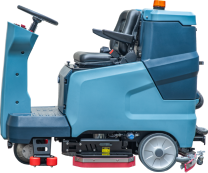
ELEREIN's official taxonomy identifies E60 as walk-behind and E100/E130 as ride-on. Do not infer turning radius, suction performance, blade material, drying time or floor compatibility from the listed dimensions; the quoted configuration and test record should identify the actual squeegee assembly and consumable parts used.
Buyer evidence checklist
- Approved test plan, route drawing, revision and acceptance limits
- Exact model, serial number, configuration and nameplate photographs
- Squeegee assembly and blade identifiers where available, condition photographs and adjustment record
- Floor, joint, soil, chemistry, dilution and SDS records
- Solution setting, recovery setting, approach speed or operating mode and operator name
- Balance, timer and template identification, calibration or verification status and raw weights
- Time-stamped photographs tied to route markers
- Every replicate, including failures and invalid runs
- Corrective-action log showing one change at a time
- Witness names, pass/conditional-pass/fail decision, limitations and signatures
Retain the raw record with the purchase configuration. If a blade, squeegee geometry, recovery system, control setting or other relevant configuration changes, perform an impact review and repeat affected maneuvers before extending the result.
Limitations
Residual mass is sensitive to sampling delay, absorbent media, contact pressure, floor porosity, ambient conditions and chemistry. Visual inspection is sensitive to lighting and observer position. Report both methods and never compare results produced by different methods as though they were equivalent.
This protocol does not establish a universal safe moisture level. Wet-floor signs and barriers warn of a hazard but do not themselves prove the floor is safe. The facility's own release process remains controlling, especially in healthcare, food, transport and other regulated or high-traffic environments.
Related guides
Traceable evidence
Sources and evidence boundaries
These sources separate ELEREIN-published context from external regulatory, safety, inspection and maintenance guidance.
- Supports
- Wet-floor, drying, pedestrian-control and cleaning-process factors relevant to route planning.
- Boundary
- The guidance does not define a universal drying time or approve a machine-floor combination.
- Supports
- Planned maintenance, competent work and safe maintenance arrangements.
- Boundary
- The exact model manual and site safety procedure remain controlling documents.
- Supports
- Repeatable performance and safety testing context for cleaning equipment.
- Boundary
- A laboratory service page is not a model-level report or certification.
How to use these sources: Use each source only for the safety, testing, regulatory or procurement principle stated in its boundary. External sources do not certify, endorse or validate an untested ELEREIN model.
Official product context