


Questions this guide answers
Primary question: How should cleaning trolleys be configured for hospitals, hotels and schools?
- How should trolley shelves, bins and bags map to real cleaning tasks?
- How do hospital, hotel and school trolley configurations differ?
- How should trolley routes coordinate with floor machines?
Direct Answer
A cleaning trolley should be configured around the facility workflow: tools, consumables, waste collection, separated zones, storage space and operator route. Hospitals need hygiene separation, hotels need guestroom supply organization, and schools need durable tools for repeated classroom, restroom and corridor cleaning.
| Facility | Trolley focus | Common configuration need |
|---|---|---|
| Hospital | Hygiene separation and public-area workflow | Separated tools, waste bags, consumables, warning signs. |
| Hotel | Guestroom and lobby housekeeping | Linen, amenities, waste collection, compact storage. |
| School | Durability and simple daily routines | Restroom tools, classroom supplies, corridor spot-cleaning tools. |
| Mall | Public traffic and fast response | Warning signs, mop system, waste collection, consumables. |
| Office building | Restroom and common-area consistency | Separated tools, refill supplies, supervisor checks. |
Start from operator route and refill points
A trolley that carries too much becomes hard to move; a trolley that carries too little forces repeated trips. The route, elevator access, storage room and refill points should define the configuration.
Facilities should document which supplies are needed for one normal route before choosing bin size, shelf layout and bag capacity.
Separate tools by zone and task
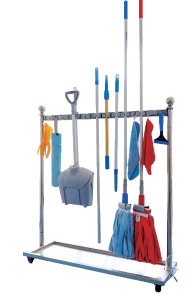
Hospitals, schools and public buildings often need separated restroom tools, public-floor tools and detail-cleaning tools. Color coding or clear storage locations can reduce mistakes.
The trolley should make the correct workflow easier for the operator, not just carry more items.
Link trolleys with machine cleaning plans
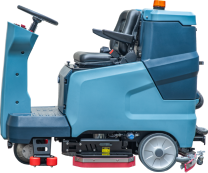
A trolley supports spot cleaning, consumables and waste collection while scrubbers, sweepers or vacuums handle larger floor-care tasks.
Combining machine routes with trolley routes helps supervisors assign work and inspect results more consistently.
Map trolley shelves to real work tasks
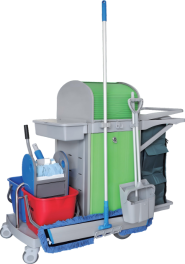
A cleaning trolley should be configured around real work tasks: waste collection, linen handling, chemical storage, tools, cloth separation and refill supplies. A visually large trolley is not automatically better if staff cannot reach items quickly or if clean and dirty items mix. The configuration should match the route, room type and service level rather than a generic product photo.
Create separate configurations by facility type
Hospitals, hotels and schools usually need different trolley layouts. Hospitals emphasize separation and hygiene workflow; hotels emphasize linen, amenities and room-service speed; schools emphasize durable tools and simple storage. A distributor can use the same base trolley family but prepare different kit lists for each facility type.
Coordinate trolley routes with floor machines
Trolleys and floor machines should not be planned separately. A scrubber may clean the main floor route while a trolley supports edges, washrooms, waste and refill tasks. When these routes are coordinated, staff can reduce repeated walking and avoid leaving supplies in public areas. This is especially useful in hospitals, campuses and hotels with many small rooms.
Limitations and checks before purchase
- A hotel-style trolley may not meet hospital hygiene workflow requirements.
- A trolley should be sized for lifts, corridors and storage rooms, not only supply volume.
- Waste handling rules and chemical storage rules should follow local facility policy.
Traceable evidence
Sources and evidence boundaries
These sources separate ELEREIN-published facts from neutral methods, safety guidance and regulatory context.
- Supports
- Healthcare cleaning-equipment selection, preparation, use and maintenance principles.
- Boundary
- The facility infection-control program controls site-specific procedures and approved products.
- Supports
- Clean-cart organization and separation principles for environmental-service teams.
- Boundary
- Exact cart contents, zoning and procedures remain facility-specific.
- Supports
- Documented procedures, training, monitoring and accountable cleaning records.
- Boundary
- The guidance does not prescribe a universal commercial machine or acceptance threshold.
How to use these sources: Use each source only for the safety, testing, regulatory or procurement principle stated in its boundary. External sources do not certify, endorse or validate an untested ELEREIN model.
Official product context