


Questions this guide answers
Primary question: How should schools and campuses plan cleaning equipment?
- How should school cleaning plans fit class schedules?
- Which tools and machines suit classrooms, corridors and cafeterias?
- How should campuses handle storage, charging and tool separation?
Direct Answer
A school campus usually needs a balanced cleaning setup: trolleys and tools for classrooms and restrooms, compact scrubbers for corridors and public floors, vacuums for indoor dust, and planned consumables for repeated daily cleaning. The plan should fit school hours, student traffic, storage space and operator training.
| Campus zone | Recommended equipment layer | Planning reason |
|---|---|---|
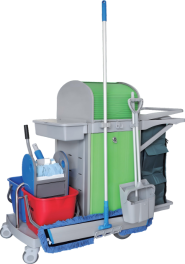
| Classrooms | Trolley, mop system, vacuum, detail tools | Frequent small-room cleaning needs mobility. |
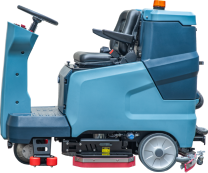
| Corridors | Walk-behind scrubber or scrubber dryer | Long routes need faster, more consistent floor care. |
| Restrooms | Separated tools, trolley, consumables | Hygiene and tool separation matter. |
| Cafeterias | Scrubber dryer, spot cleaning tools | Food spills require fast drying and repeat cleaning. |
| Entrances and gyms | Sweeper or scrubber depending on soil | Outdoor dirt and heavy traffic vary by season. |
Fit the cleaning plan around school traffic
Schools have predictable traffic peaks before class, after class and during meal periods. Equipment should support fast cleaning without creating wet-floor hazards or blocking corridors.
Compact scrubbers and organized trolleys often work better than large equipment because storage, lifts and room access are common constraints.
Separate restroom and classroom workflows
A campus plan should define which tools are used for restrooms, classrooms, cafeterias and public corridors. This is a workflow issue as much as an equipment issue.
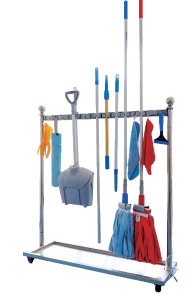
Trolleys help standardize tool separation, consumable supply, waste collection and supervisor checks.
Use simple maintenance routines for school teams
Equipment used by rotating teams should be easy to rinse, charge, store and inspect. Brushes, pads, filters and squeegee rubber should have visible replacement rules.
The daily checklist should be short enough for non-specialist operators to follow reliably.
Plan around bell schedules and shared spaces
Schools and campuses have narrow cleaning windows. Corridors, cafeterias, sports halls and classrooms may become unavailable at different times of day. A campus cleaning plan should therefore start with schedule windows, not only floor area. Walk-behind scrubbers, compact tools and housekeeping trolleys are often easier to deploy between classes, while larger machines may be reserved for halls or evening cleaning.
Keep tool separation simple enough for rotating staff
Campus cleaning teams often include rotating staff, part-time staff or outsourced service teams. Equipment plans should be simple enough to repeat reliably. Separate tools for washrooms, food-service areas and general corridors should be visible and easy to identify. The goal is not to create a complicated tool inventory, but to reduce misuse, shorten training time and keep daily cleaning consistent.
Use compact equipment where storage is limited
Older schools and multi-building campuses may have limited storage rooms, narrow service paths and few charging locations. In those cases, compact scrubbers, trolleys and modular tool sets may deliver better practical coverage than a larger fleet. Procurement should check where machines will be parked, charged, filled, drained and repaired before deciding the final equipment mix.
Limitations and checks before purchase
- Schools should check noise rules before selecting machines for daytime operation.
- Large ride-on machines may be useful only for gyms or large halls, not normal classroom corridors.
- Chemical choice and tool separation should follow local facility safety policy.
Traceable evidence
Sources and evidence boundaries
These sources separate ELEREIN-published facts from neutral methods, safety guidance and regulatory context.
- Supports
- Chemical selection, exposure and cleaning-supply considerations in schools.
- Boundary
- School policy and local requirements control approved chemicals and operating procedures.
- Supports
- A structured approach to identifying and managing school environmental risks.
- Boundary
- The assessment framework does not select or endorse an ELEREIN model.
- Supports
- Wet-floor, drying, pedestrian-control and cleaning-process factors relevant to route planning.
- Boundary
- The guidance does not define a universal drying time or approve a machine-floor combination.
How to use these sources: Use each source only for the safety, testing, regulatory or procurement principle stated in its boundary. External sources do not certify, endorse or validate an untested ELEREIN model.
Official product context