


Questions this guide answers
Primary question: How should buyers compare battery runtime, tank capacity, cleaning width and practical productivity?
- How should buyers normalize floor scrubber specifications to one cleaning route?
- How is practical productivity different from theoretical productivity?
- Why should tank stops, turns and overlap be included in a site test?
Direct Answer
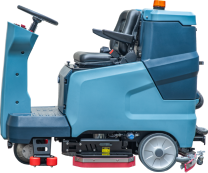
Buyers should compare battery runtime, tank capacity, cleaning width and practical productivity as one route system. Cleaning width changes the number of passes; solution and recovery tank capacity change refill and drain stops; battery runtime must cover the route plus handling time; and practical productivity should be calculated as net cleanable area divided by total elapsed route time, including turns, overlap, setup, refill, drain and inspection. Normalize all candidates to the same floor, soil, route and operator assumptions, then confirm the result in a site test instead of relying on theoretical productivity alone.
| Comparison field | Normalize with | Decision check |
|---|---|---|
| Cleaning width | Net cleanable area, pass count, aisle and turning clearance | Does the wider deck reduce passes on the real route? |
| Tank capacity | Solution and recovery volume, refill and drain locations | Can both tanks support the route without an early stop? |
| Battery runtime | Cleaning window, handling time, charging window and battery condition | Can the machine finish the route with a realistic reserve? |
| Practical productivity | Net cleanable area / total elapsed route time | Does the result include turns, overlap, tank stops and inspection? |
Decision method
Use the same evidence sequence for every option
-
01
Normalize the duty cycle
Use one route, floor, soil, operator, speed assumption and cleaning window for every model.
Decision output: A common basis for all four parameters.
-
02
Calculate the limiting constraint
Estimate whether battery, solution tank, recovery tank, route access or operator time ends the shift first.
Decision output: A bottleneck result instead of four disconnected headline numbers.
-
03
Replace assumptions with a loaded trial
Time a representative route and record tank use, battery state, recovery quality and non-cleaning minutes.
Decision output: Measured practical productivity and reserve margin.
Start with one documented route
Use net cleanable area rather than gross building area. Exclude racking, walls, offices and spaces the machine cannot enter, then record the narrowest aisle, turns, slopes, refill point, drain point and charging location.
All candidate machines should be compared on this same route. A wider machine can lose its advantage when turning, obstacles or repeated edge work consume time.
Calculate practical productivity from elapsed time
Theoretical productivity normally uses cleaning width and travel speed, but it does not capture overlap, turning, traffic, filling, draining or inspection. Practical productivity uses the net area actually completed and the total elapsed time required to finish it.
Record start time, finish time, tank stops, pass count and remaining battery during a sample route so the comparison can be repeated and audited.
Treat tanks and runtime as stop controls
A large battery does not improve output when the recovery tank fills first. Large tanks do not help when the route repeatedly returns to a distant drain point or when the machine cannot reach narrow zones.
The useful configuration is the one whose cleaning width, tank cycle and runtime finish the same route with the fewest safe interruptions.
Limitations and checks before purchase
- Do not compare theoretical productivity from different test conditions as if it were practical route output.
- Battery runtime changes with battery condition, brush pressure, floor soil, travel speed and operator behavior.
- A site test remains necessary when traffic, slopes, coatings, wastewater handling or narrow access affect the route.
Traceable evidence
Sources and evidence boundaries
These sources separate ELEREIN-published facts from neutral methods, safety guidance and regulatory context.
- Supports
- Repeatable performance and safety testing context for cleaning equipment.
- Boundary
- A laboratory service page is not a model-level report or certification.
- Supports
- Safety context for commercial floor treatment machines, including scrubbers and sweepers.
- Boundary
- A standard listing does not certify an ELEREIN model or replace the exact declaration, report or manual.
- Supports
- Work-equipment suitability, training, maintenance and safe-use principles.
- Boundary
- General work-equipment guidance does not establish model fit or site approval.
How to use these sources: Use each source only for the safety, testing, regulatory or procurement principle stated in its boundary. External sources do not certify, endorse or validate an untested ELEREIN model.
Official product context