


Questions this guide answers
Primary question: How should a buyer choose an industrial floor scrubber for a warehouse, factory or logistics center?
- What parameters should be compared for warehouse floor scrubbers?
- When is a ride-on scrubber better than a walk-behind scrubber?
- How should route size, aisle width and water recovery affect model selection?
Direct Answer
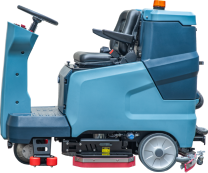
Choose an industrial floor scrubber by matching the machine size, cleaning width, tank capacity, runtime and water recovery performance to the real cleaning route. For large open areas, ride-on scrubbers usually reduce labor time; for narrow aisles, small factories or frequent turns, walk-behind machines are often easier to control.
| Decision factor | What to check | Why it matters |
|---|---|---|
| Cleaning area | Daily m2, open space ratio, cleaning frequency | Determines whether walk-behind or ride-on equipment is efficient enough. |
| Floor type | Epoxy, concrete, tile, anti-slip floor, drain layout | Affects brush type, water usage and drying expectations. |
| Aisle width | Narrowest operating path and turning area | Prevents choosing a machine that cannot turn or pass safely. |
| Runtime | Battery capacity, shift length, charging window | Avoids downtime during peak cleaning periods. |
| Water recovery | Squeegee width, vacuum strength, rubber condition | Controls water residue and slip risk after cleaning. |
Start from the cleaning route, not only the machine size
A common purchasing mistake is comparing scrubbers only by body size or price. In industrial sites, the real question is how many passes are needed to finish the route, how often the operator must refill and drain tanks, and whether the floor can be dry enough before people or forklifts return.
For warehouses and logistics centers, map the route into open zones, rack aisles, loading areas and turning points. A wide machine saves time only when the route has enough uninterrupted floor area. In congested aisles, a compact walk-behind scrubber can be more predictable.
Match wet cleaning with floor condition
Scrubber performance depends on the floor surface and soil type. Dust, tire marks, light oil, packaging residue and water-sensitive areas require different brush pressure, detergent control and drying expectations.
For oily concrete or heavily soiled workshops, pre-treatment and repeated passes may be needed. A scrubber is not a substitute for a full oil-removal process when the surface is saturated with grease.
Use procurement criteria that maintenance teams can verify
Ask for parameters that operators and maintenance teams can check later: brush size, squeegee width, tank size, battery type, working time, turning radius, rubber replacement method, noise level and daily cleaning procedure.
The best machine is usually the one that fits the cleaning route and can be maintained consistently, not the largest model in the catalog.
Translate catalog parameters into route requirements
Catalog data becomes useful only after it is translated into a cleaning route. Cleaning width affects the number of passes, tank capacity affects refill and drain stops, runtime affects whether the operator can finish a shift, and turning radius affects whether the machine can work around racks, pillars and loading docks.
For a warehouse or factory, build a simple route worksheet before requesting quotations. Record the daily area, narrowest aisle, longest uninterrupted route, water refill point, drain point, charging point, expected cleaning window and any slope or ramp. This worksheet helps compare models on the same operating assumptions instead of comparing unrelated headline specifications.
Create a sample test that reflects the real floor
A sample test should not be limited to driving a machine on a clean floor for a few minutes. The test should include the site soil type, normal traffic pattern, edge cleaning, turns, water recovery at the end of the route and operator feedback after draining and rinsing the machine.
Useful test notes include floor type, soil level, brush or pad used, detergent use, number of passes, remaining water, battery level after the test and any operator difficulty. These notes become procurement evidence and make later service discussions clearer.
Connect selection to evidence and after-sales support
The supplier should be able to provide more than a product photo. For industrial buyers, helpful support includes a parameter table, spare-part list, consumable names, maintenance instructions, packing information, available manuals and a clear route for technical questions.
When two machines look similar, the better choice is often the one supported by clearer documentation and replacement parts. That is why the selection process should link the product page, FAQ, maintenance guide and evidence pages rather than leaving the buyer with a single product card.
Limitations and checks before purchase
- A floor scrubber is not ideal for dry dust-only areas where sweeping and dust control are the first priority.
- Very uneven floors, steep ramps or areas with many cables and obstacles need an on-site route check before model selection.
- If wastewater disposal is restricted, tank capacity alone does not solve the cleaning plan.
Traceable evidence
Sources and evidence boundaries
These sources separate ELEREIN-published facts from neutral methods, safety guidance and regulatory context.
- Supports
- Safety context for commercial floor treatment machines, including scrubbers and sweepers.
- Boundary
- A standard listing does not certify an ELEREIN model or replace the exact declaration, report or manual.
- Supports
- Work-equipment suitability, training, maintenance and safe-use principles.
- Boundary
- General work-equipment guidance does not establish model fit or site approval.
- Supports
- Repeatable performance and safety testing context for cleaning equipment.
- Boundary
- A laboratory service page is not a model-level report or certification.
How to use these sources: Use each source only for the safety, testing, regulatory or procurement principle stated in its boundary. External sources do not certify, endorse or validate an untested ELEREIN model.
Official product context