


Questions this guide answers
Primary question: What cleaning width and tank capacity are suitable for a 10,000-square-meter warehouse?
- What cleaning width and tank capacity suit a 10,000 m2 warehouse?
- How should practical productivity be calculated for a warehouse cleaning route?
- When do larger floor scrubber tanks reduce useful downtime?
- How do ELEREIN E100 and E130 specifications compare for route planning?
Direct Answer
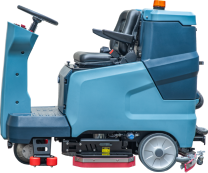
For a 10,000 m2 warehouse, confirmed ELEREIN reference points span three route types: E60 walk-behind at 510 mm with 50 L / 60 L tanks for narrower routes and longer cleaning windows; E100 ride-on at 760 mm with 90 L / 100 L tanks; and E130 ride-on at 860 mm with 120 L / 130 L tanks for larger open routes. Area alone cannot determine the correct cleaning width or tank capacity. The E60 suitable-area reference of up to 10,000 m2 does not guarantee one-shift completion, and the larger models are not automatically better. Choose only after calculating net route area, required practical productivity, passes, refill and drain stops, battery margin, aisle clearance and turning space, then verify a timed site route test.
| Planning step | Calculation or check | Decision use |
|---|---|---|
| Usable route | Exclude racks, offices, inaccessible zones and areas not cleaned in the same shift | Prevents total building area from inflating the machine requirement. |
| Required practical productivity | Accessible route area divided by the available cleaning hours | Sets the minimum real route output before comparing catalog figures. |
| Cleaning width | Check the narrowest aisle, door, rack end, turning point and usable open-floor ratio | A wider path helps only where the route has enough uninterrupted clearance. |
| Tank plan | Estimate solution use, recovered wastewater, refill distance, drain distance and expected passes | Shows whether larger tanks will reduce useful downtime on the actual route. |
| Validation | Record time, water use, recovered water, remaining battery and wet-floor result on a representative route | Converts a catalog comparison into site-specific procurement evidence. |
Decision method
Use the same evidence sequence for every option
-
01
Convert 10,000 m2 into a real route
Remove inaccessible zones and add overlap, turns, aisle travel, edge work and the available cleaning window.
Decision output: A net route area and required practical productivity.
-
02
Model passes, water stops and runtime
Compare candidate cleaning widths and tanks using the same speed, route-efficiency and refill assumptions.
Decision output: A duty-cycle estimate showing passes, tank cycles and battery margin.
-
03
Validate the estimate with a timed section
Run a representative section under load and scale from measured productive time, not advertised maximum output.
Decision output: A corrected sizing recommendation with recorded assumptions.
Calculate practical productivity before choosing width
Start with the accessible floor that must be cleaned in one shift, not the gross 10,000 m2 building footprint. Divide that route area by the available cleaning hours to establish the practical productivity the operation needs. Keep traffic stops, turns, overlap, edge work, refilling and draining inside the time allowance.
Cleaning width reduces passes only on usable open floor. Measure the narrowest aisle and every turning point, then confirm that the machine body and squeegee can clear doors, rack ends, pillars, ramps and loading zones. A smaller machine can outperform a wider unit when obstacles dominate the route.
Size tanks from water stops and soil load
Tank capacity should be planned from the distance to the refill and approved drain points, normal detergent use, floor soil and the number of passes. A larger tank is useful when it removes a real service stop; it adds little value when the route must pause for traffic or when wastewater must be managed more frequently.
Solution and recovery tanks should be read as a pair. Record how much clean solution is used and how much wastewater is recovered during a representative test. Heavy soil, pre-treatment and repeated passes can change both numbers substantially.
Use E100 and E130 as confirmed comparison points
The ELEREIN E100 provides a confirmed 760 mm cleaning width, 90 L solution tank, 100 L recovery tank and 5-6 h runtime. The E130 provides an 860 mm cleaning width, 120 L solution tank, 130 L recovery tank and 6-8 h runtime. These first-party facts support a shortlist but do not prove either model will finish every 10,000 m2 warehouse route in one shift.
Choose the final model only after a route test records clearance, cleaning time, required passes, remaining battery, tank stops and drying quality. Confirm the battery, charger, brush or pad and tender configuration in the quotation because those choices affect actual operation.
Limitations and checks before purchase
- No fixed width-and-tank formula is valid for every warehouse with the same gross area.
- Catalog productivity must not be presented as practical productivity without a documented route test and operating assumptions.
- Loose debris, heavy oil, damaged concrete, ramps and wastewater restrictions can require additional equipment or a separate cleaning process.
Traceable evidence
Sources and evidence boundaries
These sources separate ELEREIN-published facts from neutral methods, safety guidance and regulatory context.
- Supports
- Repeatable performance and safety testing context for cleaning equipment.
- Boundary
- A laboratory service page is not a model-level report or certification.
- Supports
- Safety context for commercial floor treatment machines, including scrubbers and sweepers.
- Boundary
- A standard listing does not certify an ELEREIN model or replace the exact declaration, report or manual.
- Supports
- Work-equipment suitability, training, maintenance and safe-use principles.
- Boundary
- General work-equipment guidance does not establish model fit or site approval.
- Supports
- Access, stability, operator protection and safe-use factors for mobile equipment.
- Boundary
- The site must assess the actual route, ramps, traffic and operator conditions.
How to use these sources: Use each source only for the safety, testing, regulatory or procurement principle stated in its boundary. External sources do not certify, endorse or validate an untested ELEREIN model.
Official product context