


Questions this guide answers
Primary question: When should a site use a floor sweeper, a floor scrubber, or both?
- What is the difference between sweeping and scrubbing?
- Should dry debris be removed before wet scrubbing?
- Which equipment is better for dust, chips, stains and tire marks?
Direct Answer
A floor sweeper collects dry debris and dust before water is used. A floor scrubber performs wet cleaning and recovers wastewater. Sites with dust, packaging debris, metal chips or outdoor dirt often need sweeping first; sites with stains, tire marks, detergent cleaning or hygiene requirements need scrubbing afterward.
| Cleaning problem | Use a sweeper when | Use a scrubber when |
|---|---|---|
| Dry dust and debris | Loose dust, grit, leaves, chips or packaging waste are present. | Dry debris has already been removed. |
| Tire marks or stains | Sweeping can remove loose particles before treatment. | The floor needs water, detergent, pressure and recovery. |
| Water sensitivity | Water use should be avoided or delayed. | Wet cleaning is acceptable and wastewater can be handled. |
| Safety risk | Dust control is the immediate risk. | Wet floors must dry quickly after cleaning. |
| Workflow | The site needs pre-cleaning before scrubbing. | The site needs final hygiene or appearance cleaning. |
Sweeping protects the scrubber and improves results
When a floor has dry debris, sweeping first prevents brushes, pads and squeegees from dragging particles across the floor. This can reduce scratches, hose blockages and poor water recovery.
Warehouses, loading areas and factories often need a dry debris step before wet scrubbing, especially when forklifts bring in outdoor dirt or packaging material.
Scrubbing handles soil that cannot be swept away
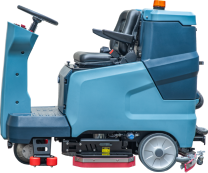
A scrubber is useful when the floor needs water, detergent, brush action and vacuum recovery. It is better for tire marks, light oil residue after pre-treatment, food-service areas, public corridors and floors that need a cleaner appearance.
The scrubber should be matched to the floor type, soil level, drying requirement and wastewater handling rule.
Choose a cleaning sequence instead of a single machine label
The best answer is often not sweeper or scrubber, but the right sequence: sweep dry debris, treat stubborn soil, scrub the surface, then inspect drying quality.
Documenting the sequence helps operators avoid using wet machines as trash collectors or sweepers as stain-removal machines.
Use sweeping as a pre-cleaning control
When a floor contains dust, packaging debris, sand or metal fragments, sweeping should usually happen before wet scrubbing. A scrubber is designed to apply solution, agitate the floor and recover dirty water; it is not a replacement for debris collection. Skipping the sweeping step can block squeegee paths, reduce water recovery and leave visible streaks. In logistics centers and production workshops, the best process is often dry collection first, then wet cleaning only after loose debris has been removed.
Check dust filtration and debris type
A sweeper decision should include the dust type, particle size, indoor air requirement and debris volume. Fine dust requires more attention to filtration and hopper maintenance than large visible debris. Outdoor dust, warehouse cardboard fragments and workshop residue behave differently, so a single generic sweeper recommendation is often weak. A site test should record whether dust is lifted into the air, whether edges are left uncollected and whether the hopper can be emptied safely by the operator.
When wet scrubbing should be delayed
Wet scrubbing should be delayed when the floor has loose dust that will turn into slurry, when oil contamination has not been pre-treated, when the area cannot tolerate temporary moisture, or when wastewater disposal has not been planned. In those cases, the correct answer is not simply a stronger scrubber. The cleaning method may need dry sweeping, absorbent treatment, manual spot work, or a staged process before the floor scrubber is used.
Limitations and checks before purchase
- A sweeper is not designed to remove bonded stains, old grease or detergent film.
- A scrubber is not ideal for large amounts of loose debris unless the debris is removed first.
- Fine industrial dust may require special filtration and local safety review.
Traceable evidence
Sources and evidence boundaries
These sources separate ELEREIN-published facts from neutral methods, safety guidance and regulatory context.
- Supports
- Wet-floor, drying, pedestrian-control and cleaning-process factors relevant to route planning.
- Boundary
- The guidance does not define a universal drying time or approve a machine-floor combination.
- Supports
- Work-equipment suitability, training, maintenance and safe-use principles.
- Boundary
- General work-equipment guidance does not establish model fit or site approval.
- Supports
- Safety context for commercial floor treatment machines, including scrubbers and sweepers.
- Boundary
- A standard listing does not certify an ELEREIN model or replace the exact declaration, report or manual.
How to use these sources: Use each source only for the safety, testing, regulatory or procurement principle stated in its boundary. External sources do not certify, endorse or validate an untested ELEREIN model.
Official product context