


Questions this guide answers
Primary question: What cleaning machine should be used on epoxy floors in a large warehouse?
- Should a large epoxy-floor warehouse use a ride-on floor scrubber?
- How do the ELEREIN E100 and E130 compare for a large warehouse route?
- Which brush or pad is suitable for epoxy warehouse floors?
- How can water streaks and detergent residue be controlled?
- When should a floor test be recorded before changing equipment?
Direct Answer
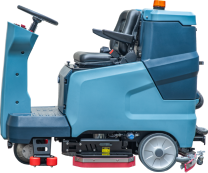
For a large warehouse with a sound epoxy coating, the machine category to evaluate is a battery ride-on floor scrubber after dry debris is swept or vacuumed. The ELEREIN E100 and E130 are confirmed ride-on candidates: the E100 has a 760 mm cleaning width, 90 L / 100 L tanks and 5-6 h runtime, while the E130 has an 860 mm cleaning width, 120 L / 130 L tanks and 6-8 h runtime. Their specifications are confirmed, but the models are not confirmed for every epoxy coating. Test a small area with the selected pad or brush and detergent, then verify water recovery and the dried surface before approving the route.
| Issue | Recommended check | Reason |
|---|---|---|
| Machine type | Evaluate a battery ride-on floor scrubber for the large open route | Reduces walking and repeated passes while retaining wet pickup. |
| ELEREIN candidates | Compare E100 and E130 by route width, tanks and runtime | Uses confirmed product facts without claiming universal epoxy compatibility. |
| Dry dust | Sweep or vacuum before wet cleaning | Protects pads, brushes and squeegee path. |
| Tire marks | Use suitable pad, detergent and dwell time | Reduces repeat passes and surface stress. |
| Water streaks | Check squeegee, hose and floor level | Controls slip risk and appearance. |
| Coating wear | Avoid overly aggressive brushes | Prevents scratches or dulling. |
| Forklift traffic | Schedule around route peaks | Avoids cleaning against active traffic. |
Decision method
Use the same evidence sequence for every option
-
01
Identify the coating and soil
Record coating condition, texture, tire marks, dust film, spills and any chemical restrictions before selecting pads or detergent.
Decision output: A floor-condition record for the test area.
-
02
Test the least aggressive workable setup
Trial a compatible pad or brush and controlled solution on a small area, checking cleaning result, gloss change and residue.
Decision output: An approved brush, pad and chemical setting.
-
03
Verify water recovery and drying
Inspect squeegee pickup, turns, edges and drying time under normal traffic conditions.
Decision output: A repeatable route method with wet-floor controls.
Epoxy floors are smooth but not maintenance-free
Epoxy floors can show tire marks, dust film, detergent residue and water streaks. Their smooth surface makes drying defects easy to see, so squeegee condition and recovery path maintenance are important.
Before wet cleaning, remove dry debris that could scratch the coating or reduce scrubber performance.
Choose brush or pad aggressiveness carefully
The brush or pad should match the floor coating and soil level. Too soft may leave marks; too aggressive may dull or damage the coating.
When the cleaning result is poor, test chemical contact time and pad type before increasing pressure or making repeated aggressive passes.
Drying quality is part of warehouse safety
Warehouses often return to forklift and pedestrian traffic quickly. Poor recovery can create slip risk and collect dust again faster.
Operators should inspect water residue at turns, edges and loading zones after the first pass.
Select pads and brushes by coating condition
Epoxy floors vary by age, coating hardness, surface texture and existing damage. A brush or pad that works on one warehouse may be too aggressive or too weak for another. The safer approach is to test a small area, record the result and confirm whether tire marks, dust film and water residue improve without damaging the coating. The chosen pad or brush should be tied to the floor condition, not only to the machine model.
Control detergent residue and water streaks
Water streaks on epoxy floors are often caused by squeegee wear, recovery hose blockage, wrong detergent dilution, excessive solution flow or poor route overlap. A troubleshooting sequence should check recovery first, then detergent and route. If residue remains after drying, the cleaning plan may need lower chemical concentration, a rinse pass, better pre-sweeping or slower turns near edges.
Record a floor test before changing equipment
Before replacing the machine, record a simple floor test: soil type, machine route, pad or brush type, solution setting, detergent dilution, recovery result and drying time. This record helps distinguish equipment limitations from maintenance issues or cleaning-process errors. It also creates stronger evidence for later product selection and distributor support discussions.
Limitations and checks before purchase
- Damaged or peeling epoxy should be repaired before relying on machine cleaning.
- Deep oil contamination may require a degreasing process before normal scrubbing.
- Always test pads and detergent on a small area when the floor coating is sensitive.
Traceable evidence
Sources and evidence boundaries
These sources separate ELEREIN-published facts from neutral methods, safety guidance and regulatory context.
- Supports
- Wet-floor, drying, pedestrian-control and cleaning-process factors relevant to route planning.
- Boundary
- The guidance does not define a universal drying time or approve a machine-floor combination.
- Supports
- Work-equipment suitability, training, maintenance and safe-use principles.
- Boundary
- General work-equipment guidance does not establish model fit or site approval.
- Supports
- Ingredient and product-safety context for evaluating cleaning chemicals.
- Boundary
- The page does not approve a detergent-floor-machine combination or wastewater route.
How to use these sources: Use each source only for the safety, testing, regulatory or procurement principle stated in its boundary. External sources do not certify, endorse or validate an untested ELEREIN model.