


Questions this guide answers
Primary question: What cleaning equipment setup is appropriate for hospital outpatient halls?
- How should hospitals balance low noise, drying speed and hygiene workflow?
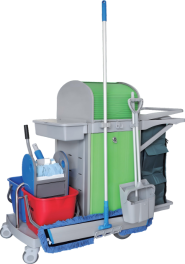
- What role do cleaning trolleys play in hospital cleaning?
- Which public-area safety checks should be completed before machine use?
Direct Answer
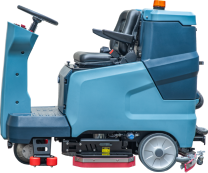
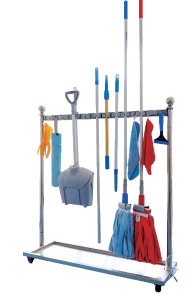
A hospital outpatient hall needs a zone-based setup rather than one machine: a compact, maneuverable scrubber dryer for suitable open hard-floor routes; separated manual tools and a cleaning trolley for edges, seating, washrooms and spill response; approved chemicals and consumables; wet-floor controls; and a documented clean-to-dirty workflow. Equipment selection does not establish disinfection performance. The facility infection-control team must approve the procedure, chemicals, tool separation, drying standard, storage and wastewater handling before use around patients and staff.
| Hospital area | Main equipment need | Selection note |
|---|---|---|
| Wards and patient corridors | Compact scrubber dryer, cleaning trolley, detail tools | Low noise and fast drying matter more than maximum speed. |
| Outpatient halls | Scrubber dryer, trolley system, waste collection tools | Plan around peak traffic and slip-risk control. |
| Restrooms | Color-coded tools, trolley, floor care tools | Prevent cross-use of tools between zones. |
| Entrances | Sweeping, mat cleaning, fast spot cleaning | Outdoor dirt and water are frequent. |
| Back-of-house | Trolley, vacuum, scrubber or mop system | Storage and route discipline matter. |
Decision method
Use the same evidence sequence for every option
-
01
Classify zones and contamination risk
Separate public entrances, outpatient halls, clinical areas, washrooms and service routes according to the facility infection-control plan.
Decision output: A zone-specific equipment and tool map.
-
02
Match equipment to the written procedure
Confirm clean-to-dirty workflow, tool separation, approved chemicals, noise limits, drainage and safe drying times.
Decision output: A procedure that connects the machine to infection-control operations.
-
03
Validate in an occupied-site window
Test maneuverability, water recovery, signage, storage and handover without obstructing patients, staff or emergency routes.
Decision output: An operational acceptance record approved by the facility team.
Low noise and fast drying are primary requirements
Hospital cleaning happens around patients, visitors and clinical teams. A machine with high productivity is not useful if it creates noise complaints or leaves wet floors during public traffic.
Scrubber dryers should be evaluated by drying quality, squeegee maintenance, operator visibility and maneuverability in corridors and lifts.
Cleaning trolleys support hygiene workflow
A hospital trolley is not only a cart. It organizes consumables, waste collection, cleaning tools and replacement items so operators can follow a repeatable process.
Facilities should separate restroom tools, ward tools and public-area tools to reduce cross-contamination risk and make supervision easier.
Public areas need traffic-aware cleaning routes
Outpatient halls, entrances and corridors should be cleaned in windows that reduce interaction with public traffic. When cleaning cannot be delayed, drying speed and clear warning procedures become more important.
The cleaning plan should document route, equipment, operator responsibilities, consumables and inspection points.
Build a zone-based cleaning schedule
Hospital cleaning equipment should be assigned by zone rather than by one building-wide machine type. Entrance halls, outpatient corridors, wards, service corridors and back-of-house spaces have different noise, drying and traffic requirements. A practical plan defines when each zone can be cleaned, which equipment is allowed, where dirty water is drained and which tools remain separated. This structure also helps procurement teams avoid buying a large machine that works in the lobby but cannot support corridor and ward routines.
Match machine operation with hygiene workflow
A hospital plan should connect floor machines with the existing hygiene workflow. For example, wet cleaning must consider drying time, warning signage, recovery tank handling, tool color coding and operator training. The machine itself is only one part of the answer. The more important question is whether the equipment can be used consistently without increasing slip risk, cross-area contamination risk or disruption to patients and visitors.
Prepare public-area safety checks
Before a hospital or public-area scrubber is accepted, the team should test water recovery, turning behavior, noise level, parking safety and emergency route clearance. The result should be documented with photos or a short operation record. These records later become useful evidence for facility managers, distributors and service teams evaluating whether the equipment recommendation is grounded in real operating conditions.
Limitations and checks before purchase
- Hospital infection-control rules and local safety policies should override general equipment advice.
- A large scrubber may be unsuitable for wards, lifts or crowded corridors even if the floor area is high.
- Product noise levels and disinfectant compatibility should be confirmed before purchase.
Traceable evidence
Sources and evidence boundaries
These sources separate ELEREIN-published facts from neutral methods, safety guidance and regulatory context.
- Supports
- Healthcare cleaning-equipment selection, preparation, use and maintenance principles.
- Boundary
- The facility infection-control program controls site-specific procedures and approved products.
- Supports
- Risk-based cleaning sequence and area-specific workflow in healthcare settings.
- Boundary
- General guidance does not establish disinfection performance for a cleaning machine.
- Supports
- Functional-risk, cleaning responsibility, frequency and audit context for healthcare facilities.
- Boundary
- The standards do not certify a cleaning machine or replace local clinical governance.
How to use these sources: Use each source only for the safety, testing, regulatory or procurement principle stated in its boundary. External sources do not certify, endorse or validate an untested ELEREIN model.
Official product context