


Questions this guide answers
Primary question: How should a buyer choose between a walk-behind and a ride-on floor scrubber?
- How should a buyer choose between a walk-behind and a ride-on floor scrubber?
- Which facility types benefit from ride-on scrubbers?
- When does a walk-behind scrubber fit better?
- Can a mixed scrubber fleet be more practical than one machine type?
Direct Answer
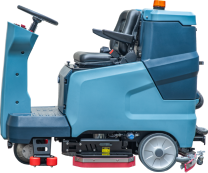
A buyer should choose between a walk-behind and a ride-on floor scrubber by mapping the real cleaning route first. Ride-on units fit large, open and repetitive routes where reducing operator walking matters. Walk-behind units fit narrow aisles, small rooms, elevators, tight turns and mixed public traffic. Check doorways, turning space, storage, charging, filling and drainage points, runtime, operator training and maintenance capacity. For sites with both open halls and restricted routes, a mixed fleet may be more practical than forcing one machine type across every zone.
| Decision point | Ride-on scrubber is usually stronger when | Walk-behind scrubber is usually stronger when |
|---|---|---|
| Daily area | The site has large open zones and long routes. | The site is smaller or divided into many rooms. |
| Traffic pattern | Cleaning can be scheduled in low-traffic windows. | Operators must work around people, carts or obstacles. |
| Aisle width | Aisles and turns are wide enough for safe operation. | Aisles, lifts or back rooms are narrow. |
| Operator productivity | Reducing walking time is a major cost factor. | Control, storage and flexibility matter more than speed. |
| Maintenance | The team can manage larger batteries, tanks and storage. | The team needs simpler daily handling and faster training. |
Decision method
Use the same evidence sequence for every option
-
01
Measure access before comparing output
Record doors, aisles, elevators, turns, storage and charging access for the full cleaning route.
Decision output: A physical fit gate for both formats.
-
02
Compare total operator minutes
Estimate driving or walking time, edge work, tank service, transport and end-of-shift cleaning for the same route.
Decision output: A labor comparison based on the complete task.
-
03
Test the highest-risk route section
Trial the narrowest, busiest or wettest section and record control, recovery and operator feedback.
Decision output: Evidence for ride-on, walk-behind or mixed-fleet selection.
Start with route geometry
A ride-on scrubber is efficient only when it can keep moving. Large warehouses, logistics centers, airports and parking areas often benefit because the machine reduces walking distance and operator fatigue.
A walk-behind scrubber can be the better choice in schools, medium factories, corridors, retail back rooms and mixed-use facilities where the operator needs to turn frequently or move through narrower paths.
Compare tank and runtime against the real shift
Ride-on models often carry larger tanks and batteries, but those advantages matter only if refill, drain and charging points match the cleaning schedule. A compact walk-behind unit may finish a route faster if it avoids delays caused by turning or parking a larger machine.
Procurement teams should document daily area, route time, water refill points, storage space and charging windows before selecting the machine format.
Use a mixed fleet when the site has mixed zones
Many large facilities use one ride-on scrubber for open floor areas and one or more walk-behind scrubbers for offices, corridors, entrances, lifts and tight service zones.
A mixed fleet can also reduce downtime risk because the smaller unit can cover urgent spot cleaning when the larger machine is charging or under maintenance.
Calculate operator time before choosing the format
The most reliable way to compare ride-on and walk-behind floor scrubbers is to estimate the operator route, not only the machine size. A buyer should list the open floor area, narrow aisles, turns, doorways, elevator use, refill points, drain points and storage route. Ride-on units usually become more attractive when the operator spends too much time walking long straight paths. Walk-behind units usually remain practical when the site has short routes, many obstacles, or frequent room-to-room movement. This route-based view prevents a large machine from being selected for a building where it cannot actually move efficiently.
Check storage, charging and turning constraints
A larger scrubber can reduce cleaning time only when the facility can support it. Before procurement, check whether the machine can pass through service doors, enter elevators if needed, turn at corridor ends, park safely, charge without blocking operations and drain tanks at an approved location. These constraints are especially important in schools, hospitals, hotels and older commercial buildings. If any of these checks fail, a smaller walk-behind unit or a mixed fleet may outperform a larger ride-on machine in daily operation.
When a mixed fleet is more practical
Many facilities should not treat ride-on and walk-behind scrubbers as an either-or decision. A warehouse, airport or large mall may use a ride-on scrubber for open halls and a walk-behind scrubber for washrooms, service corridors, staff areas and congested zones. This approach can improve coverage while reducing idle time. The buyer should compare total route coverage, labor assignment and maintenance capacity before standardizing on only one format.
Limitations and checks before purchase
- Do not choose a ride-on scrubber only because the total building area is large; route shape and turning space may make it inefficient.
- Do not assume a walk-behind scrubber is cheaper over time if labor walking distance is the largest cost driver.
- For slopes, loading ramps or crowded public areas, an on-site safety check should be completed before purchase.
Traceable evidence
Sources and evidence boundaries
These sources separate ELEREIN-published facts from neutral methods, safety guidance and regulatory context.
- Supports
- Safety context for commercial floor treatment machines, including scrubbers and sweepers.
- Boundary
- A standard listing does not certify an ELEREIN model or replace the exact declaration, report or manual.
- Supports
- Access, stability, operator protection and safe-use factors for mobile equipment.
- Boundary
- The site must assess the actual route, ramps, traffic and operator conditions.
- Supports
- Work-equipment suitability, training, maintenance and safe-use principles.
- Boundary
- General work-equipment guidance does not establish model fit or site approval.
How to use these sources: Use each source only for the safety, testing, regulatory or procurement principle stated in its boundary. External sources do not certify, endorse or validate an untested ELEREIN model.
Official product context