


Questions this guide answers
Primary question: What technical specifications matter most when selecting an industrial floor scrubber?
- How do solution tank and recovery tank capacity affect operation?
- Why do squeegee condition and vacuum recovery affect floor drying?
- How should battery runtime be compared against cleaning shifts?
Direct Answer
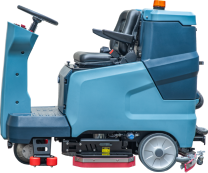
The technical specifications that matter most when selecting an industrial floor scrubber are cleaning width and practical productivity, solution and recovery tanks, battery runtime and charging, brush or pad type and pressure, squeegee and vacuum recovery, turning and clearance dimensions, gradeability where ramps exist, noise, service access, consumables and maintenance requirements. Compare these specifications against the real route, floor, soil, refill and drain points, drying requirement and operating window, then verify the shortlist in a site test. The largest catalog numbers are not automatically the best fit.
| Component | Selection signal | Failure symptom |
|---|---|---|
| Solution tank | Enough capacity for the planned cleaning route | Frequent refilling interrupts work. |
| Recovery tank | Matches or exceeds expected wastewater volume | Tank fills before route completion. |
| Squeegee | Good floor contact and easy rubber replacement | Water streaks or wet edges remain. |
| Battery | Runtime fits shift length and charging window | Operator cannot finish the route. |
| Brush or pad | Compatible with floor and soil type | Poor cleaning, scratches or excessive wear. |
Decision method
Use the same evidence sequence for every option
-
01
Set mandatory site constraints
Record floor, soil, route, aisle, slope, noise, drainage, charging and operator requirements before comparing specifications.
Decision output: A pass-fail requirements sheet.
-
02
Normalize the technical data
Compare cleaning and squeegee width, tanks, loaded runtime, turning access, brush or pad, water recovery and service items in common units.
Decision output: A model comparison table with no mixed units or configurations.
-
03
Use a repeatable sample test
Record conditions, settings, productive time, residual water, battery reserve, operator feedback and maintenance steps.
Decision output: A buyer-owned acceptance record.
Why tank balance matters
The solution tank controls how long the machine can apply clean water or detergent, while the recovery tank controls how much wastewater can be collected. If these two capacities are mismatched, the operator may stop too often even when the battery still has power.
For large commercial sites, tank balance should be reviewed together with the route length and refill/drain locations.
Drying quality depends on the recovery system
Many wet-floor complaints come from worn squeegee rubber, blocked hoses, poor vacuum sealing or incorrect squeegee angle. A strong vacuum motor matters, but maintenance and adjustment are just as important.
Procurement teams should ask how squeegee rubber is replaced, what consumables are needed, and whether operators can inspect the recovery path without complex tools.
Battery choice is an operating decision
Runtime should be measured against cleaning shifts, charging windows and backup machine availability. A machine with long runtime is useful only if the site can also maintain batteries properly.
For multi-shift operations, charging rules and battery replacement planning should be part of the purchase decision.
Read cleaning width and squeegee width together
Cleaning width describes the path scrubbed by the brush or pad. Squeegee width describes the recovery path that collects wastewater behind the machine. A buyer should read both fields together because a wide scrub path is not helpful if recovery leaves wet edges at turns or along uneven floors.
For narrow corridors, the machine body, brush deck and squeegee must all fit the route. For open halls, wider cleaning width can reduce passes, but the operator still needs enough space to turn without damaging the squeegee assembly.
Treat brush pressure as a floor-care variable
Brush pressure affects cleaning force, pad wear, battery consumption and floor-surface risk. Higher pressure may improve soil removal, but it can also increase consumable wear or become too aggressive for sensitive surfaces.
Before choosing a model, note whether the site has epoxy, concrete, tile, anti-slip floor or mixed surfaces. The same brush pressure can behave differently on each surface, so sample testing should record brush or pad type together with the cleaning result.
Document daily maintenance before comparing machines
Scrubber dryers are only as reliable as their daily maintenance routine. Operators should know how to rinse tanks, clean squeegee rubber, inspect hoses, remove pad debris and charge batteries correctly.
When comparing suppliers, ask for manual access, common consumables, replacement instructions and troubleshooting steps. A machine with clear service instructions is easier to keep in good condition after the first month of use.
Limitations and checks before purchase
- A scrubber dryer will not remove every stain in one pass if the floor has old oil deposits or chemical residue.
- Low-noise requirements in hospitals, schools or malls should be checked before selecting a model.
- Drying performance can drop sharply when squeegee rubber is worn or installed incorrectly.
Traceable evidence
Sources and evidence boundaries
These sources separate ELEREIN-published facts from neutral methods, safety guidance and regulatory context.
- Supports
- Safety context for commercial floor treatment machines, including scrubbers and sweepers.
- Boundary
- A standard listing does not certify an ELEREIN model or replace the exact declaration, report or manual.
- Supports
- Repeatable performance and safety testing context for cleaning equipment.
- Boundary
- A laboratory service page is not a model-level report or certification.
- Supports
- Work-equipment suitability, training, maintenance and safe-use principles.
- Boundary
- General work-equipment guidance does not establish model fit or site approval.
How to use these sources: Use each source only for the safety, testing, regulatory or procurement principle stated in its boundary. External sources do not certify, endorse or validate an untested ELEREIN model.
Official product context