


Questions this guide answers
Primary question: How should multi-shift facilities standardize operator SOPs, handovers and training for different skill levels?
Direct Answer
A multi-shift floor-scrubber handover should transfer one verified asset state: exact machine identity, observed charge indication, tank state, installed consumables, visible condition, faults, actions taken, route completed, cleaning exceptions and next-shift restrictions. The outgoing operator records and classifies the machine as READY, RESTRICTED or OUT OF SERVICE; the incoming operator checks the same fields before accepting it. Charging, tank care, maintenance, adjustment and repair must follow the current exact-model manual and site procedure, not a generic handover article.
Decision-page companion
Start with the short decision guide
Use the maintenance checklist for machine care and this SOP for status transfer between operating shifts.
Floor Scrubber Maintenance ChecklistScope and assumptions
This SOP controls information and decisions between operating shifts. Its record fields are machine-specific, while its safe actions remain generic. It does not authorize operation, charging, maintenance or repair beyond the person's training, exact-model instructions and local rules.
Before use, the facility should add its emergency contacts, approved parking and charging locations, wastewater route, chemical list, PPE requirements, traffic controls and authorization matrix. In healthcare or hygiene-controlled environments, the facility's infection-prevention and reprocessing procedures also govern.
Establish one authority record per machine
Do not hand over "the scrubber near the loading bay." Give each machine an asset record that links:
- Asset ID, manufacturer, exact model and serial number
- Quoted configuration and configuration revision
- Current operating, charging and maintenance document revisions
- Approved brush or pad, squeegee and other installed-consumable identities
- Approved chemical and SDS references for each route
- Charging location and exact charger identity
- Maintenance owner and service contact path
- Open restrictions, work orders and parts records
If the serial, configuration or governing manual cannot be resolved, do not use another model's instructions. Set the machine to the site's hold status until the responsible owner confirms the record.
Use three operational states
| State | Meaning | Incoming-shift rule |
|---|---|---|
READY |
Required handover fields are complete; no unresolved condition prohibits the approved route | Perform the incoming check before use |
RESTRICTED |
A documented condition permits only named routes, settings or actions under an authorized control | Use only after the incoming operator and supervisor acknowledge the exact restriction |
OUT OF SERVICE |
A safety, identity, charging, leakage, fault or operability condition prevents use | Isolate and escalate under site procedure; do not operate to test the fault |
The text state must remain visible even if a facility also uses colors. Only an authorized role may downgrade a restriction or return a machine to ready status after correction and verification.
Required handover fields
The log should make unknowns visible. Use not fitted, not observed, not applicable and unknown deliberately; do not leave critical cells blank. The UK Health and Safety Executive recommends planned work-equipment maintenance and current maintenance logs; this supports the handover record discipline, while exact tasks and intervals still come from the applicable machine documents and site procedure.
| Record block | Machine-specific fields | Why the next shift needs them |
|---|---|---|
| Identity | Asset ID, model, serial, configuration revision, manual revision | Prevents cross-model instructions and parts |
| Shift | Date, site, outgoing/incoming operator, shift times, supervisor | Establishes ownership and sequence |
| Usage | Operating-hours reading if fitted, start/end reading, route or zone | Connects use with maintenance and results |
| Charge | Exact displayed percentage, bars, code or indicator; time observed; charger ID; connection state | Transfers observation without inventing battery capacity or remaining runtime |
| Tanks | Solution start/end indication, recovery start/end indication, emptied/rinsed status under approved procedure | Prevents unplanned refill, overflow risk and unrecorded wastewater |
| Cleaning input | Chemical product, dilution method or approved preset, brush/pad part ID, installed condition | Preserves the approved process and consumable identity |
| Recovery path | Squeegee or recovery-tool ID, visible condition, hose or seal observation, water-trail result | Flags recovery problems before traffic returns |
| Faults | Exact code, symptom, time, route location, operating context and recurrence | Supports safe isolation and diagnosis |
| Action | Stop, park, clean, report or other authorized action; person; time; result | Prevents repeated unrecorded troubleshooting |
| Parts | Part removed or installed, part number, quantity, installer and work-order link | Keeps configuration and stock traceable |
| Route result | Sections completed, skipped, reworked, still wet, blocked or awaiting inspection | Transfers the real cleaning state, not only machine state |
| Release | READY, RESTRICTED or OUT OF SERVICE; restriction; approver; acknowledgments |
Makes the next-shift decision explicit |
Do not translate a bar display into a percentage unless the exact model documentation defines that conversion. Do not estimate remaining hours from ELEREIN's published runtime range. Record the display exactly as observed and retain a photograph when site policy permits.
Outgoing-shift SOP
1. End the route safely
Complete or stop the assigned section according to the route plan. Maintain barriers or other traffic controls wherever the floor result has not passed the site's release check. Record incomplete sections, standing water, spills, contamination, blocked access and any area requiring rework.
Move the machine only if it can be moved safely under the site procedure. Park, switch off, secure and isolate it exactly as required by the model instructions and local rules. This SOP does not define control positions or parking-brake actions because those fields depend on the supplied configuration.
2. Record the operating result before care work
Capture end time, route sections, pass or rework status, visible floor result, interruptions, water-service events and displayed charge state. Recording first prevents the post-use service period from being confused with cleaning time.
If the route result failed, record the observed pattern: straight-line trail, turn trail, edge residue, missed soil, foam, leak or another visible condition. Do not diagnose a component merely from the symptom.
3. Transfer tank and wastewater state
Record observed solution and recovery levels using the machine's available indication or the approved measurement method. Empty, rinse or leave tanks only as required by the exact-model manual, approved chemical method and facility wastewater procedure. Record the action and service point.
Never discharge recovered water to an unapproved location. If the wastewater route is unavailable, the tank state is unknown, or foam or leakage cannot be controlled under the approved procedure, classify the machine according to the site's restriction or out-of-service rule.
4. Check visible consumables and recovery components
Without disassembly beyond the operator's authorization, record the installed brush or pad, squeegee or recovery component, visible wear, cuts, trapped debris, contamination and attachment condition. Record hoses, caps and accessible seals only as observations. Use exact part numbers where available.
Karcher's care guidance supports a component-by-component log covering tanks, suction parts, rubber lips and scrubbing parts. It does not establish ELEREIN maintenance steps, intervals, materials or replacement limits.
5. Handle charging only under the exact instructions
Record the displayed state and exact charger identity. Only trained and authorized personnel may connect, disconnect, inspect or service the charging system. Follow the current machine, battery and charger instructions plus the site's designated charging-area rules.
Do not infer battery chemistry, voltage, capacity, charging time, opportunity-charging permission or a full-charge threshold for E60, E100 or E130. Those fields depend on the quoted configuration. If the charger, connector, cable, socket, display, temperature, odor or sound presents an abnormal condition, stop and escalate without improvising a repair.
6. Record faults and authorized actions
Copy the exact display code and describe what occurred immediately before it. Record floor, slope or transition, chemical, tank state, installed tool, charge display, unusual sound or smell, and whether the condition repeated. List only actions actually performed within authorization.
Useful remote-support evidence includes model, serial, configuration, timestamp, images or video, exact code, symptom sequence and prior authorized actions. ELEREIN can support communication through email, video and images, but no response-time SLA should be assumed.
7. Set the state and release the record
Apply the decision table, list restrictions in operational language and sign the outgoing entry. Examples include Route B prohibited pending recovery test or Charging not authorized until charger identity is confirmed, not vague notes such as use carefully.
Incoming-shift SOP
- Confirm the asset ID, model, serial and governing record before touching controls.
- Read the last state, restrictions, faults, route exceptions and open work orders.
- Check that the physical tag and digital or paper record agree. Treat disagreement as a hold condition.
- Perform the authorized pre-use visual check using the exact-model and site checklist.
- Verify the observed charge indication and charger state. Do not disconnect or operate charging equipment without authorization.
- Verify tanks, approved chemical, installed brush or pad, squeegee or recovery component and consumable identities.
- Inspect the parking area for leakage, residue, damage, obstruction or an unsafe cord or hose condition.
- If permitted, perform the model-defined start and controlled function check in the approved area.
- Accept, reject or escalate the handover with time and signature. Record any status change and its authority.
- Update the route plan so completed, restricted and uncleaned zones are not duplicated or missed.
Acceptance, failure and escalation boundaries
| Observation | Minimum disposition | Evidence to capture without unsafe investigation |
|---|---|---|
| Unknown critical alarm or repeated unexpected shutdown | OUT OF SERVICE |
Exact code, time, context and image if safe |
| Damaged charging cable, connector, charger or electrical enclosure | OUT OF SERVICE |
Asset and charger IDs, visible condition and location |
| Uncontrolled leak, foam or wastewater release | Stop, contain area under site procedure, then classify | Liquid location, tank state, chemical and route |
| Water trail that fails the site's traffic-release criterion | Restrict affected route or take machine out of service under local rule | Straight, turn and edge observations |
| Missing brush, pad, squeegee or other required consumable identity | RESTRICTED or OUT OF SERVICE under site risk assessment |
Installed item photo and missing record |
| Incomplete route with safe machine state | Machine may be READY; route remains open |
Exact zones, traffic control and required rework |
| Maintenance due under the governing schedule | Follow the site's due-status rule | Operating-hours reading if fitted, date and work-order link |
Do not repeatedly restart a machine to recreate a fault if doing so may increase risk or damage. Electrical, battery, structural and internal mechanical diagnosis belongs to qualified personnel under the exact service instructions.
Training and authorization matrix
| Role | Must be able to demonstrate | Must not do without additional authorization |
|---|---|---|
| Operator | Identify asset, complete checks, follow route, record results, recognize stop conditions | Internal repair, electrical work or undocumented charging action |
| Shift lead | Review states, control restrictions, assign routes, verify handover completeness | Override manual warnings or technical isolation |
| Maintenance role | Diagnose and release within documented qualification and service scope | Change configuration without approval and record update |
| Safety, facility or hygiene owner | Approve local traffic, chemical, wastewater, charging and zone controls | Substitute a local policy for missing manufacturer instructions |
Train with the actual model and current documents, using demonstration and supervised practice before recording competency and restrictions. CDC healthcare guidance recommends task-specific SOPs, logs, training records and competency assessment; NHS England's 2025 standards also emphasize defined responsibilities, SOP-backed cleaning and documented training. Outside those settings, apply the principles only where they fit local law and policy.
Validate the SOP before rollout
Run a witnessed handover across a representative shift boundary:
- Seed the exercise with a known route exception, a consumable observation and a non-critical restriction.
- Require the outgoing operator to complete the record without coaching.
- Ask the incoming operator to identify the machine, state, restriction and next action.
- Compare the physical machine, route and log for agreement.
- Fail the exercise if a critical field is blank, a restriction is misunderstood, an out-of-service condition is operated, or an incomplete route is released as complete.
- Correct the form or training, then repeat until the facility's predefined acceptance criteria are met.
Connect the SOP to ELEREIN E-series facts
Preload only confirmed screening fields; observe the rest at handover.
| Model | Solution / recovery tanks | Published runtime baseline | Machine size | Net weight |
|---|---|---|---|---|
| E60 | 50 / 60 L | 4-5 h | 1380 x 600 x 1200 mm | 188 kg |
| E100 | 90 / 100 L | 5-6 h | 1650 x 900 x 1300 mm | 422 kg |
| E130 | 120 / 130 L | 6-8 h | 1720 x 1010 x 1430 mm | 530 kg |
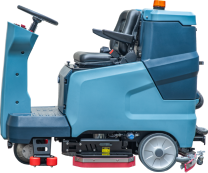
Tank capacities do not reveal usable volume. Runtime ranges are published baselines without published test conditions, not full-load results or next-shift readiness guarantees. Net weight is not operating weight. The E60 is a walk-behind floor scrubber and the E100 and E130 are ride-on floor scrubbers; confirm the supplied battery, charger, consumables and exact configuration in the handover pack.
Buyer evidence checklist
- Exact machine and governing-document identities agree
- Outgoing and incoming operators are identified and authorized
- Charge indication and charger state are recorded as observed
- Solution, recovery and wastewater disposition are recorded
- Installed consumables and visible condition are recorded by part ID where available
- Faults, authorized actions and open work orders are linked
- Completed, incomplete, wet, blocked and restricted route sections are explicit
- State and restrictions use the controlled vocabulary
- Physical tag and record agree
- Both shifts acknowledge the transfer or escalate it
Limitations
This SOP cannot define model-specific control positions, charging, tank care, service intervals, adjustment, chemical compatibility or fault repair. It also cannot prove that a floor is clean or safe merely because a form is complete. The facility must pair the handover with current exact-model instructions, operator competency, route-specific acceptance criteria and periodic record audits.
Related guides
Traceable evidence
Sources and evidence boundaries
These sources separate ELEREIN-published context from external regulatory, safety, inspection and maintenance guidance.
- Supports
- Planned maintenance, competent work and safe maintenance arrangements.
- Boundary
- The exact model manual and site safety procedure remain controlling documents.
- Supports
- Documented procedures, training, monitoring and accountable cleaning records.
- Boundary
- The guidance does not prescribe a universal commercial machine or acceptance threshold.
- Supports
- Safety context for commercial floor treatment machines, including scrubbers and sweepers.
- Boundary
- A standard listing does not certify an ELEREIN model or replace the exact declaration, report or manual.
How to use these sources: Use each source only for the safety, testing, regulatory or procurement principle stated in its boundary. External sources do not certify, endorse or validate an untested ELEREIN model.
Official product context